
Articles & News
Executive analysis on Agentic AI — strategy, architecture, operations, and governance. Pragmatic, vendor-neutral, outcome-driven

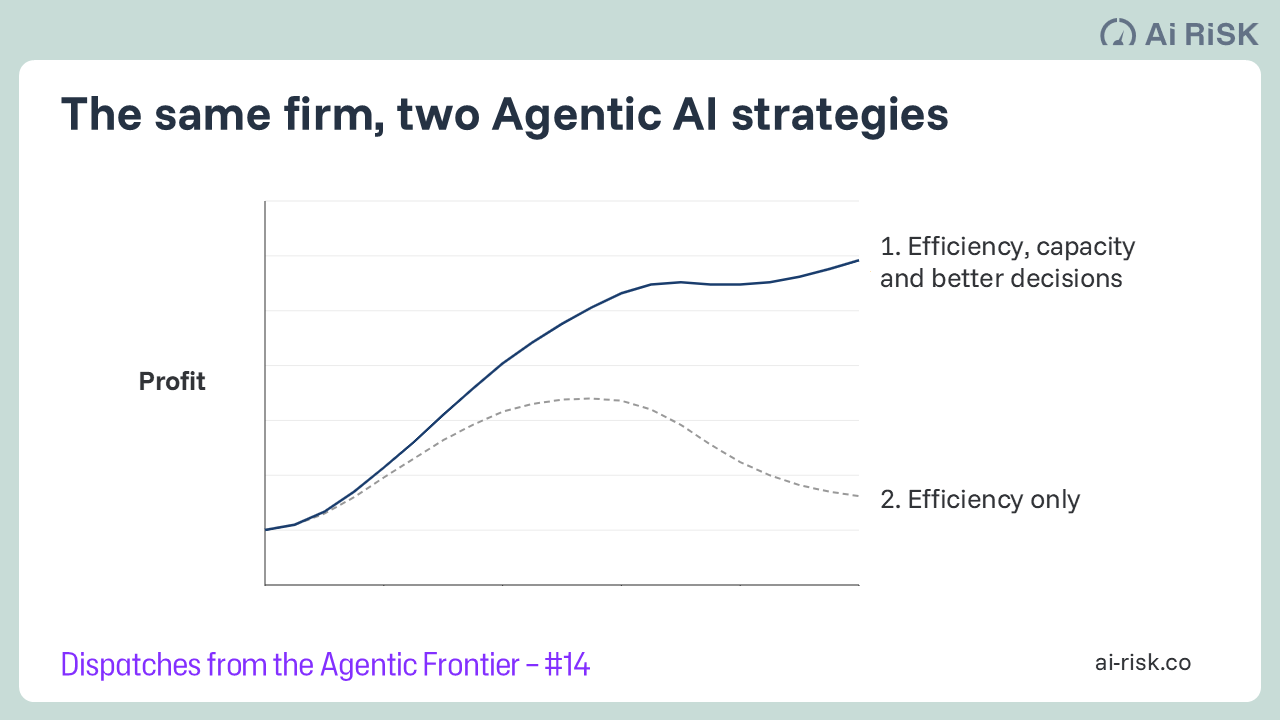
Three Kinds of Value from Agentic AI. Your Business Case Only Funds One.
Approve twenty sound Agentic AI business cases and together they make a decision nobody was asked to make: the whole budget buys the one kind of value every rival can buy too. Efficiency gains depreciate. Capacity gets rebuilt. Only better decisions appreciate – and almost nobody measures them. This is the test to run before your next case is written.
Your Company Is Throwing Away Its Thinking
Every day your company throws away its thinking. The decision reaches a system, the outcome reaches the financial accounts, and the reasoning stays in one person's head until they leave. Agentic AI is the first technology that can keep it, and keeping it is now the advantage.
Your AI Spend Is Buying Parity, Not Advantage. The World's Biggest Bank Just Admitted It.
JPMorgan’s CEO has told investors that AI delivers no edge: the gains get competed away to customers, so the better margins AI business cases promise never arrive. He is right, and it reaches well beyond banking. This dispatch shows the way out: AI your rivals cannot buy, built on your firm's own reasoning.
Agent-Rich, Asset-Poor
Enterprises are adopting AI agents faster than any category of enterprise AI before them, and keeping almost none of the intelligence those agents generate. This article sets out the sovereignty test that separates firms building Intelligence Capital from firms renting efficiency: three questions for your board, the market evidence from the financial services sector, and the one piece of architecture to build rather than buy.
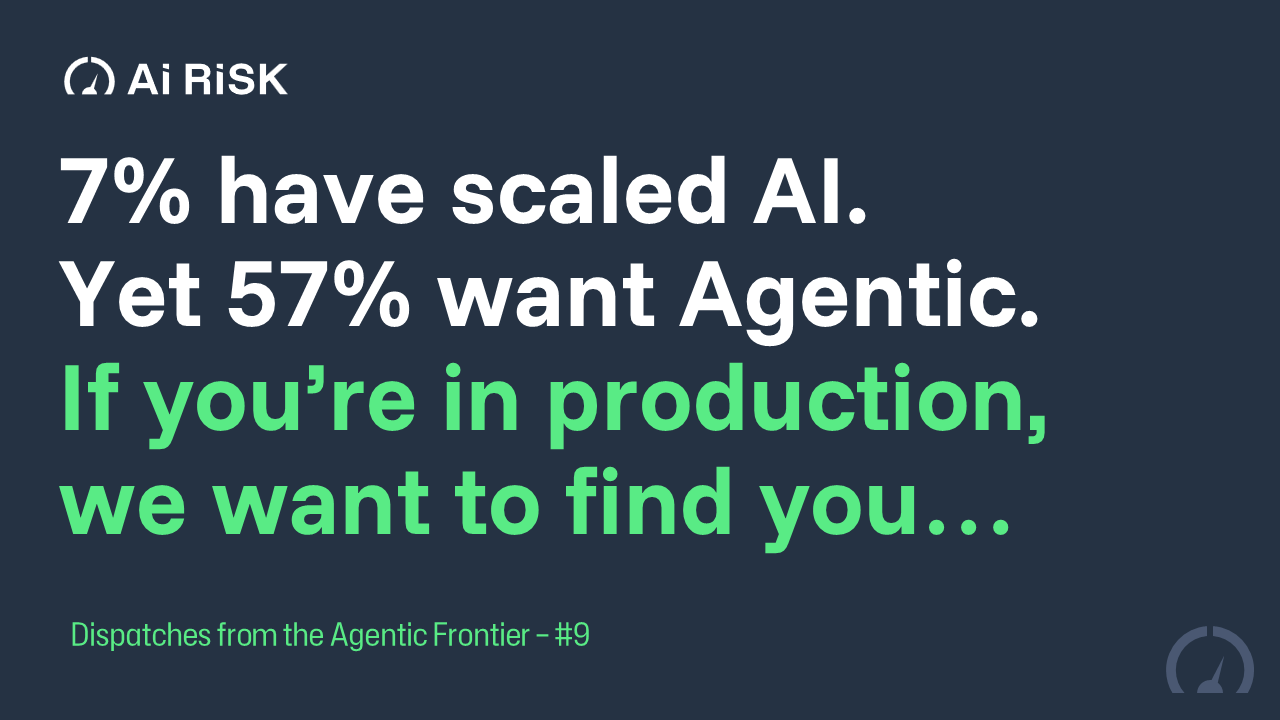
The 7% Problem: Why Agentic AI Will Be Harder to Scale
Seven per cent of insurance carriers have scaled AI at enterprise level. Fifty-seven per cent now list agentic AI — a harder technology — as a top investment priority. The gap between these two numbers is the central strategic challenge of 2026, and the organisations that have closed it share four characteristics the rest of the industry has yet to adopt. This Dispatch examines the scaling record, the agentic-specific data, and what distinguishes the leaders who moved into production. It also introduces the Top 5 Agentic Faces in Insurance — the first programme recognising C-suite leaders who shipped agentic AI across European insurance — and the 7 July event where winners will be announced.
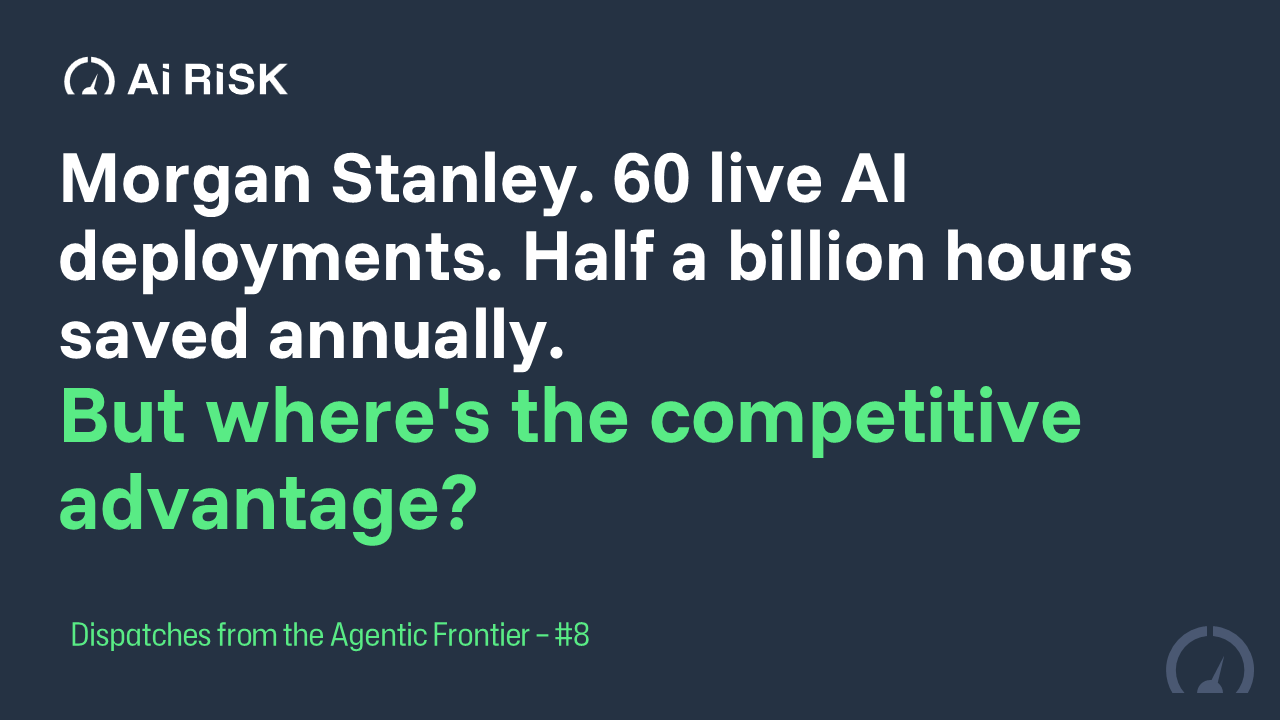
Morgan Stanley Has 60 Live AI Deployments. But No Durable AI Advantage.
Morgan Stanley ranks 5th globally for AI. 60 deployments. Impressive results. But does any of it create durable advantage? The architectural question every leader must answer.
Agentic Commerce: The Distribution Shift Your Board Hasn't Discussed Yet
In February 2026, the S&P 500 Insurance Brokers Index fell 11% in a week. Bank of America followed with a $15 billion quantification of AI disintermediation risk. Most boards still haven't discussed it once. This article explains what the signal means: a new class of buyer — AI agents acting autonomously on behalf of consumers — is being built now, and the structural positions in insurance distribution are being claimed before most organisations have noticed. Covers the five types of Agentic Commerce, the AI visibility gap already opening between carriers, the five-layer readiness diagnostic, and why the architectural decisions made in 2026 will determine competitive position in 2028.
Microsoft Just Wrote the Agentic AI Playbook. Here Is What It Leaves Out.
Microsoft's "Frontier Firm" playbook is the first enterprise agentic AI guide built from three years of company-wide deployment — but the destination it defines contains no mechanism for compounding advantage. This analysis examines what Microsoft got right, identifies what the framework omits, and shows why organisations that follow the playbook without building a Coordination Layer will arrive at the same destination as every competitor who followed it. The April 2026 consensus — from Microsoft, McKinsey, BCG, Bain, and PwC — is remarkably coherent on governance, adoption, and measurement, and remarkably silent on Intelligence Capital.
What McKinsey, BCG and Bain Are All Missing About Agentic AI
McKinsey, BCG and Bain have each published serious agentic AI frameworks in the past six months. They are worth reading. They point in the same direction. And they share one analytical gap that has direct consequences for which AI investments will prove durable — and which will converge toward market parity.
The gap is not in their intent. It is in their framework. All three describe what competitive advantage in the AI era looks like. None of them identifies the mechanism that makes it permanent rather than temporary. That mechanism — and why time is the one strategic variable that cannot be purchased retroactively — is what this piece addresses.
This works for SEO because it contains the natural search terms (McKinsey, BCG, Bain, agentic AI, competitive advantage, insurance) without being written for a crawler. It reads as a genuine proposition.
The AI Blind Spot Lemonade, Chubb (and most insurers) Share
Lemonade's CEO argues that incumbent insurers cannot close the AI advantage that digital challengers have built — regardless of how much they invest in technology. His compounding physics argument is correct. His three diagnostic KPIs are a genuine contribution. But the piece applies the right argument to the wrong capability layer, and contains one critical silence that his investors should be pressing him on.
This analysis examines what Schreiber gets right, where the argument needs qualification — particularly for insurers outside personal lines — and why a December 2025 commitment from Chubb, the world's highest-margin P&C insurer, reveals something his framework cannot explain: both Lemonade and Chubb are racing, from opposite directions, toward exactly the same strategic destination. Neither has described what lies beyond it.
That gap is where Intelligence Capital lives — and where durable competitive advantage in insurance will be won or lost.
JPMorgan Spends $2 Billion a Year on AI. Here's the Layer They Haven't Built Yet.
JPMorgan Chase has built the most impressive AI infrastructure in financial services — and it is still missing the one thing that creates durable competitive advantage. That paradox is worth sitting with before you study their playbook. What they have built is extraordinary. What they have not yet built is the layer that will determine which organisations — in any knowledge-intensive industry — are still ahead in 2030.
Three AI Signals Worth Sharing with Your Board This Month
When AI shifts from reactive to agentic, consumption doesn't grow linearly — it grows by orders of magnitude. And the cost of that intelligence is falling 1,000x. Three signals from the frontier that should change how your board plans for AI.
The AI Your Competitors Can’t Buy
Most enterprise AI investment is buying parity. The same tools, from the same vendors, delivering the same efficiency gains your competitors will match within two years. A different class of AI investment — one that generates Intelligence Capital — creates advantage that compounds over time and cannot be replicated by purchasing the same technology later. This article introduces the framework for knowing the difference.

The Current AI Agent Hype Misses the Point. Here’s What We’ve Learned from the Last Two Years of Deployment.
Everyone's talking about AI agents as if they're the future. We've been deploying them in production for two years. The results — and the lessons — aren't what you'd expect.

Agentic AI Isn't a Tool. It's Your New Workforce.
Most companies are stuck at Level 1 AI maturity today — running pilots, wondering why nothing transforms. The shift to Level 4 agentic workforces AI changes everything: 3x operational capacity, costs cut by 80%, expertise that compounds permanently. This isn't optimisation. It's a new workforce model. And for those who move first a 24-month implementation lead creates permanent advantage.
Your New Competitive Advantage: ‘Agentic Operational Capacity’
By 2028, knowledge-intensive companies will occupy one of two positions. Position A: 3-5x operational capacity, serving markets competitors can't profitably access, growing without proportional headcount. Position B: Explaining why they saw the transformation but approached it tactically. The difference isn't technology access — everyone has that. It's Level 3-5 Agentic AI implementation capability.

Agentic Commerce: The Insurance Distribution Takeover
Insurance is uniquely exposed to ‘Agentic Commerce’ - AI agents buying and selling insurance on behalf of humans - due to five factors:
Standardized products, price-sensitive consumers: Insurance comparison is tedious—consumers want to delegate this.
Complex comparison processes: AI can do it better.
Renewal vulnerability: Consumer agents will conduct automated policy reviews.
Intermediary commoditization: AI makes aggregation instant.
Hidden information architecture: Carriers with agent-readable APIs will capture disproportionate share in early pilots.

Agentic AI: How to Maximise ROI through Strategic Deployment?
Agentic AI drives the greatest growth and value potential when deployed strategically, rather than focused on existing processes and short-term efficiency gains. This video explains why and how, using cutting-edge case studies and proven frameworks.

Insurtech Insights London : How to Leverage a Near-Infinite Synthetic Workforce
The most urgent risk facing modern businesses — especially in insurance — isn’t cyber threats or bad AI investments. According to Simon Torrance (Founder of AI-Risk), it’s being outcompeted by rivals who deploy agentic AI better and faster than you.

100 Trillion - The Important Number Every CEO Missed in Microsoft's Recent Announcements
100 trillion AI tokens processed last quarter prove the Infinite AI Workforce is already here. When Satya Nadella announced that Azure processed "over 100 trillion tokens [in Q3]" during Microsoft's recent earnings call

The Shift Has Already Started. The Winners Are Scaling Agentic Teams Now
The Agentic Enterprise Blueprint maps your transformation from pilot purgatory to exponential scale.