Your AI Spend Is Buying Parity, Not Advantage. The World's Biggest Bank Just Admitted It.
Dispatches from the Agentic Frontier is a regular intelligence briefing for leaders in knowledge-intensive sectors. Each dispatch translates evidence from the frontier of agentic AI — practitioner experience, investor signals, strategy research, market events — into what it means for enterprise leaders building for competitive advantage. Some dispatches are field reports from practitioners who are 12–18 months ahead. Others synthesise emerging research. All are filtered through the Intelligence Capital framework developed in The AI Your Competitors Can’t Buy.
Introduction
In March I argued that JPMorgan's roughly $2 billion of realised AI value rested on capability any rival can buy. Four months later, on 14th July, Jamie Dimon, its chief executive told analysts the same thing.
This Dispatch updates the analysis and explains why he is right. It also shows the way out: AI your rivals cannot buy and whose gains stay with you.
The lessons and principles in this article apply to every knowledge-intensive business, big and small, not only giant banks. Insurance industry players, for example, are two to three years behind the banking sector on AI. They have the opportunity to learn these lessons at JPMorgan's expense rather than their own.
What Jamie Dimon said
On JPMorgan's second-quarter earnings call on 14th July, he told analysts that "you don't uniquely benefit from AI". His reasoning was that, in a competitive market, every company ends up with the same AI capability, so the gains get passed through to customers as lower prices and better service. His proof is computerisation: if banks had kept the gains from twenty years of it, he said, margins today would be 80%. They are nowhere near, because the customer got the benefit.
Good news for customers. A serious problem for anyone funding an AI programme, because most AI business cases promise exactly what Dimon says will not happen: better margins and a lead over competitors.
The man running the most advanced AI programme in financial services is telling you those promises will not survive contact with your market.
He is right, and the problem is wider than banking. Insurers, brokers and every other business built on expertise - financial services or otherwise - buy their AI from the same vendors their competitors use, so the same arithmetic applies to them. It applies to the transformation programmes now being bought wholesale from consultancies and the frontier model labs. And it matches the diagnosis I published on JPMorgan in March.
There is one exception, and it follows from Dimon's own argument. Gains get competed away only when rivals can buy the same capability. An AI system that learns from your firm's own decisions, and keeps the reasoning behind them, builds a capability no rival can buy, so those gains stay with you. Almost no one is building this yet.
His numbers make his own argument - and provide a preview for your company
The big banks buy from the same short list of vendors: the same fraud-screening platforms, the same document processing, the same AI assistants built on the same frontier models. None of it separates one bank from the next, and the gains have gone where he says they go: to the customer.
Exactly the same has happened in insurance where, despite intensive digitisation in certain segments, margins haven’t changed for decades, revenue growth still simply tracks GDP and ‘protection gaps’ (huge untapped market demand) remain unserved.
If we set Jamie Dimon’s numbers against his claim they look, on first sight, like a contradiction: why spend this much if nothing unique comes back? An annual technology budget of around $20 billion, roughly 11% of the bank's $182 billion in annual revenue, with about $2 billion of it tagged directly to AI. Almost 1,000 AI use cases, of which he counts only around 50 as ‘the really important ones’. Jobs already cut by 30 to 40% in discrete areas, with most of those people redeployed elsewhere in the bank. His CFO forecasts meaningful acceleration in token costs through H2, and 150,000 of the bank's 300,000-plus employees use its internal LLM every week.
Eight weeks earlier, Dimon had told Bloomberg the bank would hire more AI specialists and fewer traditional bankers. So within two months the same CEO said two things: we are investing more into AI, and AI gives us no unique benefit. Both are true at once. The spend is mandatory, but the advantage is not included.
This revelation also overthrows the way the business press has viewed enterprise AI since 2023: as an AI race, with JPMorgan out in front and everyone else obliged to catch up. Matching the leader buys what the leader has, which the leader has just valued for you: parity.
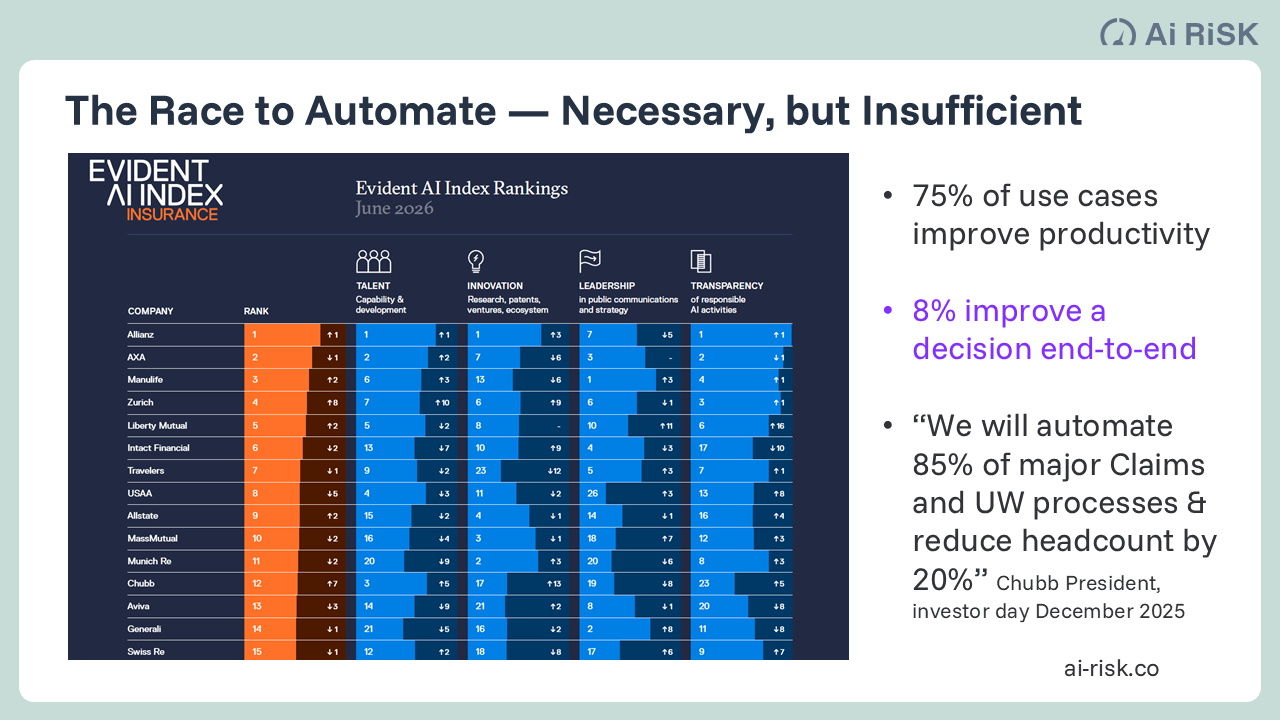
But why should a leader of a company - big or small - in another sector care what a bank CEO says about AI? It’s because of the size of JPMorgan's head start. JPMorgan has topped the Evident AI Index for banking for four consecutive years. If we compare it to major insurers, it’s ahead of AXA and Allianz - the two most AI-advanced insurance incumbents in the world - by a considerable margin on the same benchmark metrics.
Dimon's conclusion is a preview of the economics that every player in a knowledge-intensive sector will meet in two to three years, disclosed early and free of charge. His deployment themes - document processing, fraud and client work - are, for an insurance carrier or broker, submission triage, claims handling, bordereaux processing and fraud detection, and research ingestion, trade surveillance and client reporting for an asset manager.
AI gains only dissipate if rivals can buy what you bought
The typical consulting response to Dimon's sentence is to execute better: adopt faster, govern harder, redesign more deeply.
Execution differences are real, and JPMorgan's governance moves - AI leadership on the Operating Committee, ownership embedded in every business line - remain ahead of most of the market. But advice sold to every firm improves no firm's relative position, and superior execution of a symmetric capability converges too. It just converges later.
Morgan Stanley shows how far excellent execution reaches. Fifth on the Evident Index, 60 live AI deployments, and every disclosed one running on a single LLM vendor. Its former firmwide head of AI publicly advises executives to buy the orchestration layer rather than build it, because it is commoditised. Without meaning to, he has just explained why Dimon is right: gains get competed away only when rivals can buy what you bought, and anything sold as a commodity is, by definition, on sale to your rivals too. Same frontier models, same vendors, same integration patterns, refreshed every quarter.
JPMorgan itself swaps its foundation models roughly every eight weeks, and Dimon answered a key question on the call without being asked: the same capability, he noted, will reach smaller competitors over time through Fiserv, FIS and the fintechs.
I call this condition the Parity Problem: an AI investment that reproduces purchasable capability buys parity, and rivals close the gap within months.
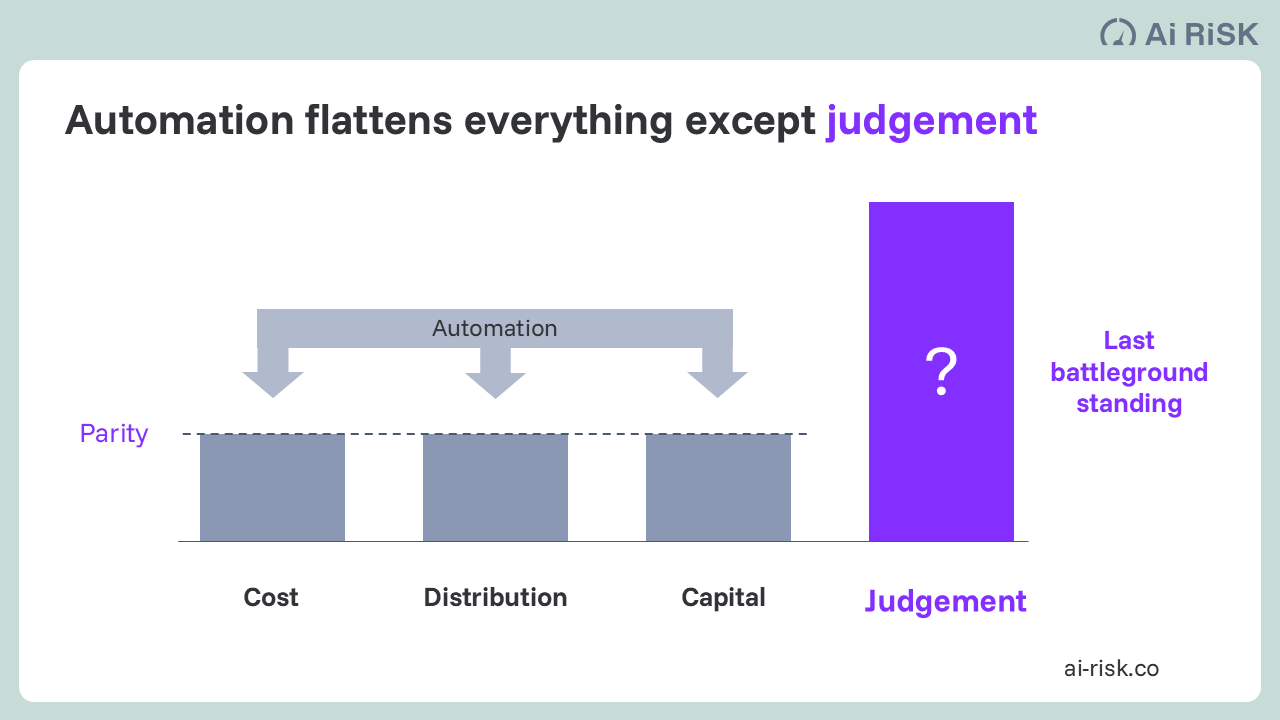
This condition cuts every AI portfolio in two:
Depreciating AI is capability built from what anyone can buy, efficiency tools whose gains are competed through to the customer via the mechanism Dimon describes.
Appreciating AI is a system that compounds the reasoning that only the firm possesses, which the mechanism cannot reach, because there is nothing symmetric to transfer.
Even McKinsey's strategists now concede the first half of this in a recent article "Is that AI agent worth it?": process advantage is becoming harder to defend and that the layer creating competitive advantage is the ‘context’ a firm captures systematically, including its decision precedents.
In my experience Enterprise leadership behaviour has not caught up with this diagnosis. The gap between the two parts of an AI portfolio is where the next three years of advantage will be decided.
Buying transformation industrialises the sameness
On 23rd July, Brown & Brown, a $24 billion, 23,000-person US insurance broker, announced an AI-first transformation delivered by a consortium of Anthropic, McKinsey and Accenture: Claude deployed to every teammate, Claude Code across the whole engineering organisation, with self-reported pilot gains of 2x to 8x in developer productivity. Much of it is sensible. A value management office measuring outcomes is exactly right. Proving value in pilots before scaling is what I always recommend (so long as the pilots are part of a clear and holistic strategy, which is not always the case in practice). The pilot figures - vendor-adjacent though they are - are believable, because coding is where agentic gains land quickest.
What the deal cannot deliver, though, is a sustainable edge over other brokers. The identical trio of suppliers is for hire by every competitor next quarter, and developer productivity is squarely the category Dimon says gets competed through to clients.
A transformation anyone can hire is an advantage no one keeps.
The question the announcement does not answer is the one that will matter come 2029: when the engagement ends, which accumulated reasoning belongs to Brown & Brown, and which lives on in the suppliers' platforms and playbooks?
The standard for answering this question was, ironically, published ten days before the deal, by the deal's own lead adviser. McKinsey Quarterly told enterprises to treat systematically captured context as a crown jewel to be kept inside the business, and stated that the default direction in sourcing is no longer to outsource more.
None of this is an accusation - the consortium would fairly reply that capturing Brown & Brown's context is part of the job; modern transformation playbooks include it. But capture and ownership are different facts. Capture inside a supplier's platform does not make the reasoning yours at exit; ownership is whatever the contract says it is.
The implication is that any transformation contract, this one included, has three risks to answer for wherever reasoning sits in a vendor's system, per my March article:
If the vendor holding your reasoning is acquired - and AI vendors are consolidating fast - years of your accumulated judgement change hands with it, and the acquirer sets the terms of access from then on.
Standard terms often let vendors improve shared models with customer interactions.
Reasoning records that cannot be exported mean starting accumulation from zero.
A good counter-example also comes from the insurance sector. AXA Group is scaling more than 60 agentic use cases on one common platform while its group CTO publicly rejects vendor lock-in: easier and faster, he concedes, but "not the path we will take". Keeping the expertise that gives AXA its edge, inside AXA, is the stated aim.
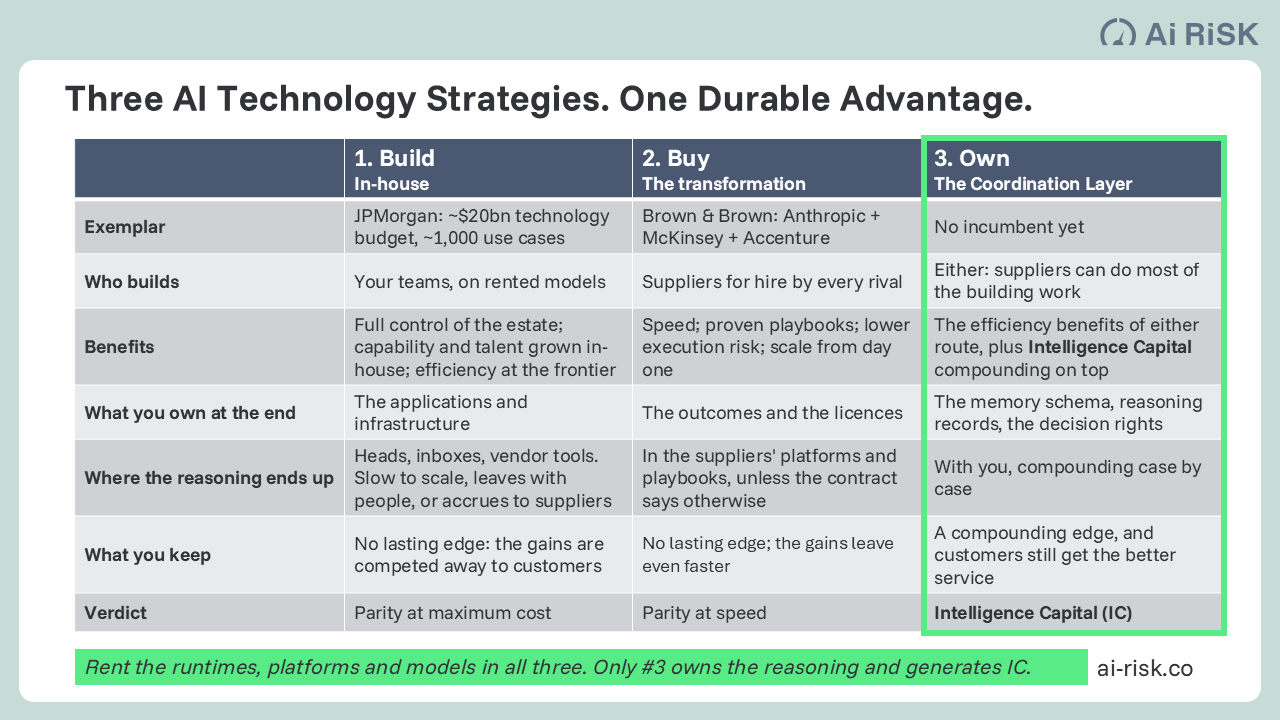
Let’s set the three approaches side by side: JPMorgan built everything in-house and its CEO reports value, but no unique benefit; Brown & Brown is buying its build from suppliers available to every rival; AXA is defending sovereignty via architecture.
But one important verb - ‘testing’ - carries other sectors’ maturity gap vis-a-vis banking: AXA's 60 use cases are in testing, Morgan Stanley's 60 are in production. And sovereignty only protects what you put inside it. Switchable vendors and in-house expertise keep AXA independent; they do not, by themselves, record any reasoning or generate Intelligence Capital as an appreciating asset. On the public evidence that owned memory does not yet exist, AXA is where my March analysis left JPMorgan: closer to the threshold than others, but not yet across it.
The notion of ‘sovereignty’ reached the vendors' own marketing this month too. Satya Nadella, CEO of Microsoft, now warns enterprises that AI labs are quietly extracting their know-how; Alex Karp, founder of Palantir, made a similar case on CNBC on 1 July and is now selling a sovereign AI stack with Nvidia and has has published a nine-point sovereignty manifesto.
I strongly recommend taking this evolution in messaging - whereby the sellers of the dependency have adopted the vocabulary of independence - with a pinch of salt. What they offer covers where your data, weights and compute sit. The question I suggest you ask sits one layer up: who owns the record of how your decisions were made, which no amount of infrastructure sovereignty supplies by itself.
Why ‘later’ never arrives
Efficiency first is the rational choice for executives, and nearly everyone is making it today. In my team’s client work, even leaders who have engaged seriously with us on the Intelligence Capital accumulation argument can default to efficiency as the starting point for implementation. The board logic is sound: the wins are real…and they land inside a bonus year.
At a conference we ran with InsTech, an insurance community, on 7th July, in front of 300-plus professionals, AXA UK walked through an eight-agent solution handling higher-value motor injury claims end to end, describing an 85% saving on the process. Allianz Partners now pays some travel claims in around 60 seconds. The agentic wave is getting into production, and it works.
Some of the most rigorous (traditional) advice on the market backs the default efficiency focus. BCG's recent Executive Perspective, "Driving Sustained Structural Cost Advantage with Applied AI", from earlier this month, tells executives to set hard headcount targets, warns that hesitation compounds against them, and tops its maturity ladder at ‘structural cost advantage’.
But its own surveys sit uncomfortably beneath that ambition:
60% of companies report no material value from AI (still)
5% generate value at scale
Investment is roughly doubling anyway, to about 1.7% of revenue this year (for leading players).
Cost advantage built from symmetric tooling is the exact category Dimon says gets competed away. Intelligent leaders are likely to fund it regardless, because annual incentive horizons pay for gains that arrive within a year, and accumulation pays outside them.
Fast-following is the weakest strategy in agentic AI, yet leaders are directly incentivised to adopt it.
The trouble with "efficiency now, the other stuff later" is what the efficiency wave leaves behind. It records outcomes, not reasons. What was decided survives in the file; why it was decided is stuck in the heads of the people (and leaves when they do), the vendor releases and the retired workflows. Every month reasoning goes unrecorded is unrecoverable: it is judgement your firm paid for and can’t re-use at scale.
By the time "later" comes around, the ten thousand cases that would have trained the asset have been processed without it.
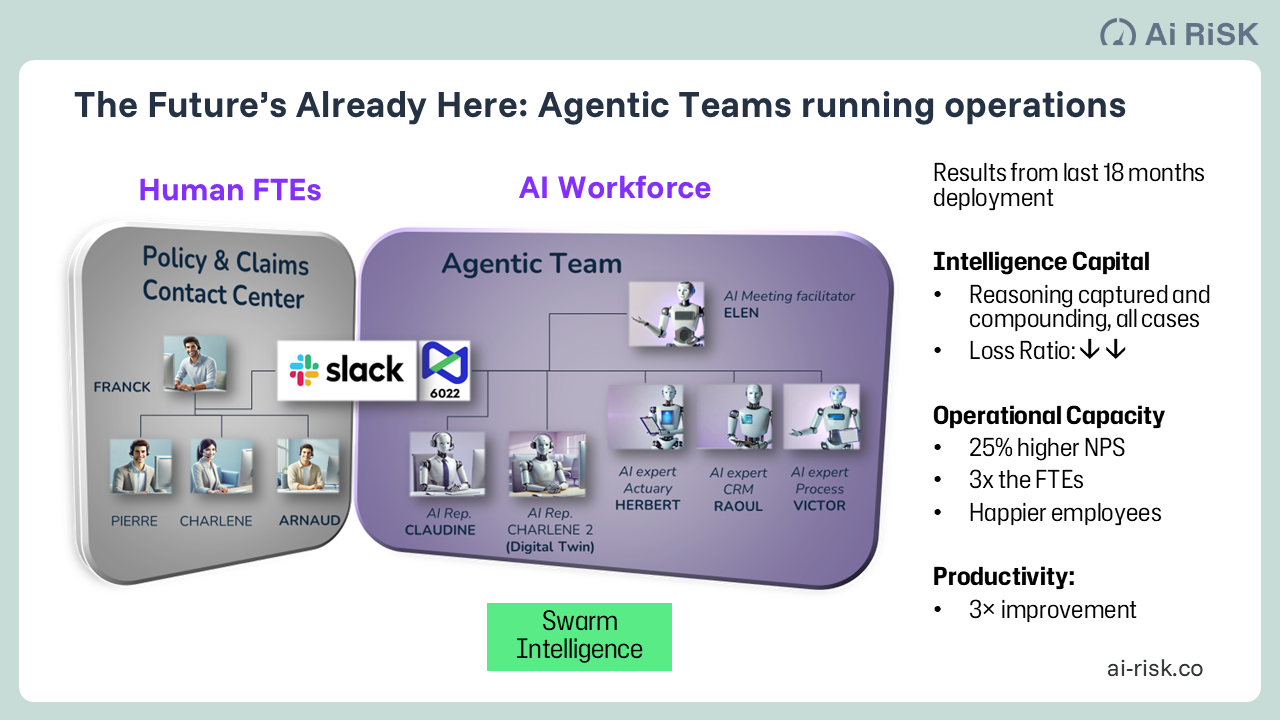
No established firm we can point to, on the public record or in our client work, is capturing its reasoning, encoding it into software and compounding it as Intelligence Capital yet. One proof of what is possible is AI-native rather than incumbent: a business my colleagues helped build eighteen months ago runs largely on a team of collaborating AI agents and operates at a profitability level around double the industry average for its product. It also serves a customer segment that the traditional industry felt was uneconomical, which points to the larger prize: owned reasoning does more than defend the business you have; it opens markets you could never tackle before. (I’ll be writing an in-depth analysis of how to drive true disruptive innovation from AI in shortly). The category exists. Among incumbents - and many challengers today - it is empty today, and that emptiness is the golden opportunity for ambitious companies.
Build the AI no rival can buy
Here’s my suggestion as a next step: when you take your AI portfolio into its next review, or if you are just developing a proper AI strategy and building a portfolio, test each line item against Dimon's sentence: "you don't uniquely benefit from AI." The question to ask of each item is simple: could a rival buy this too? For most items the honest answer is yes.
The right response to this review is reclassification: keep funding efficiency projects as the cost of staying in the game, and bank the near-term savings, which are real (if done well). What should be removed from the business case is any durability promise: any claim that the margin gain lasts once rivals are running the same tools. The CEO of the best-resourced bank on earth has just dismantled this type of claim.
The items that survive should share one property: they should retain what they learn, in a form no competitor can buy.
Accumulated organisational reasoning that compounds with every case the firm decides is what I refer to as Intelligence Capital: Technology × People × Time. And only the first factor is for sale. Whether it compounds under agentic AI at the rate the precedents suggest - for example, common law, underwriting guidelines, the proprietary systems banks once built on commodity computing - is the open question, because no incumbent (as far as I’m aware) has run the full experiment yet. The first firm to run it will own both the asset and the proof that it works - and that comprises a significant prize for a bold leader.
Building it should be managed as a contrained and bounded piece of engineering, not a multi-year IT overhaul. It does not replace your core systems; it sits on top of them. What gets built is a per-case record that holds the facts, the open questions, the decision and the reasoning behind it, written into by every AI agent, agentic system and person that touches the case, and owned by the firm.
That memory and its exploitation, including the encoded rules governing what each AI agent or agentic system may decide alone, is enabled by what we call the Coordination Layer, the one layer of the enterprise stack that most companies do not yet have. The buy-or-own split runs through every component of it rather than between components. We recommend renting the runtimes, the platforms and the models and owning the memory schema, the reasoning records and the decision rights.
One test informs supplier decisions, including an outsourced transformation deal: would the Coordination Layer keep working if that supplier were removed in 36 months?
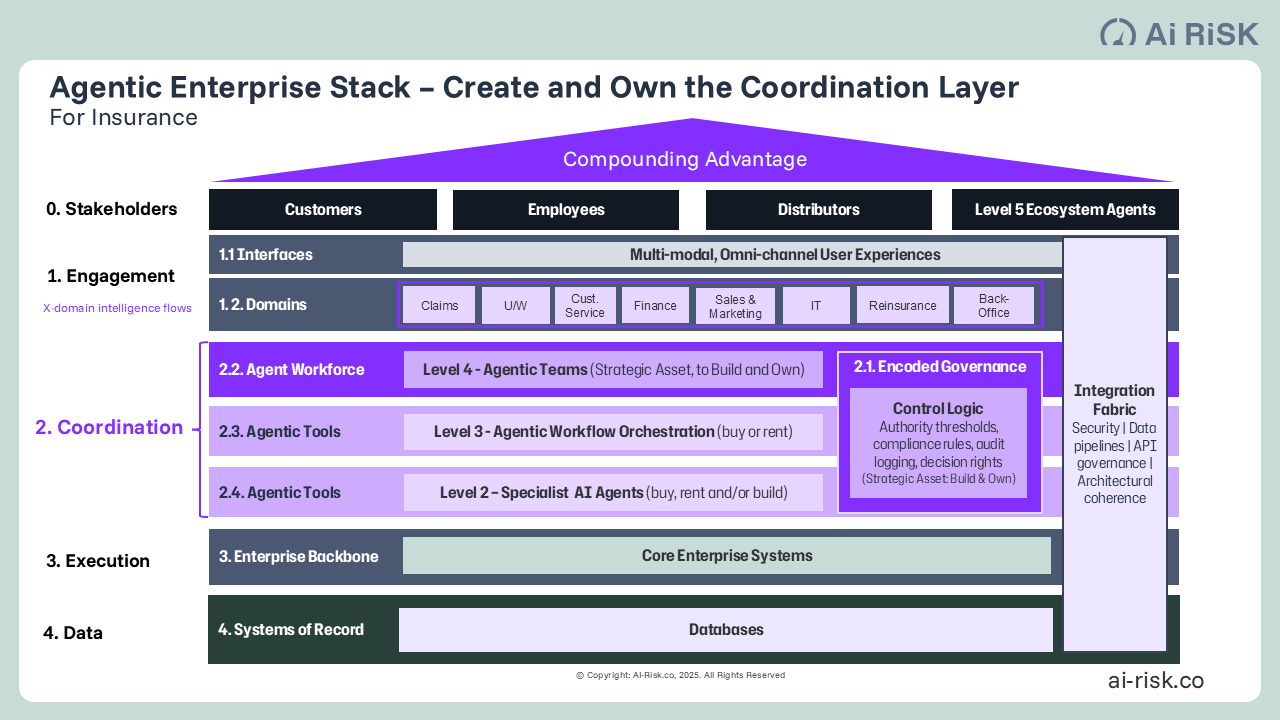
Example of The Coordination Layer for insurance. The same principles apply for other sectors.
It’s interesting to note that companies in some sectors - like Insurance - hold a particular advantage that seems, at first, as a burden. Regulation already obliges insurers to explain decisions, log overrides and keep audit trails across underwriting and claims, which is precisely the raw material of Appreciating AI. Insurance is a sector whose regulator forces them to collect Intelligence Capital's inputs. The regulator makes market participants collect the raw material, but only the participants themselves decide whether it stays as compliance exhaust or compounds in value.
So the enterprise efficiency wave survives Jamie Dimon's sentence on one condition: that institutional memory is architected in, in parallel, from the first deployment. Everything else in the build (the workflows, the agentic assistants, the governance) can be added later, at whatever pace suits your company’s appetite and budget. The memory cannot wait: a record starts on the day you switch it on, and the cases handled before that day never enter it.
Jamie Dimon has run an experiment at a scale that you and your company never will, and disclosed the result without charge. Read his sentence against your portfolio before your competitors read it against theirs. The question for your next AI review is which of your current or future investments would survive it.
Simon Torrance is CEO of AI Risk, an Agentic AI strategy and implementation consultancy. AI Risk architects the Coordination Layer for knowledge-intensive businesses as part of its Accelerator process. For the foundations of the Intelligence Capital thesis, see "The AI Your Competitors Can't Buy".