Agent-Rich, Asset-Poor
Introduction
Almost no organisation yet has a real agentic AI strategy; most boards are still working out what agents are. That is not a problem to apologise for. It is the window of opportunity.
This article gives leaders the three-question ownership test to apply before the deployments arrive, the market evidence on where the value is leaking, and the single piece of architecture to decide up front, because the advantage at stake compounds with operating time, and the first accumulator will own both the asset and the evidence.
Agentic AI is Accelerating
AI agents are the fastest-growing category of enterprise AI: at the largest banks they rose from 15% to 31% of new AI deployments in a single quarter, according to Evident Insights a benchmarking firm. The firms deploying them are, so far, keeping almost none of the intelligence they generate. Each agent, or agentic system, produces reasoning on the company's behalf, and in every firm where it has been measured, that reasoning either evaporates or stays with the vendor.
This condition has a shape: agent-rich, asset-poor.
On current trajectories it hardens within three years, because the advantage at stake compounds with operating time, and lost months cannot be bought back. By 2029 the agent population at a typical enterprise will rival its workforce in number, a growing share built by staff rather than bought, and the firm will own almost none of the thinking they produce.
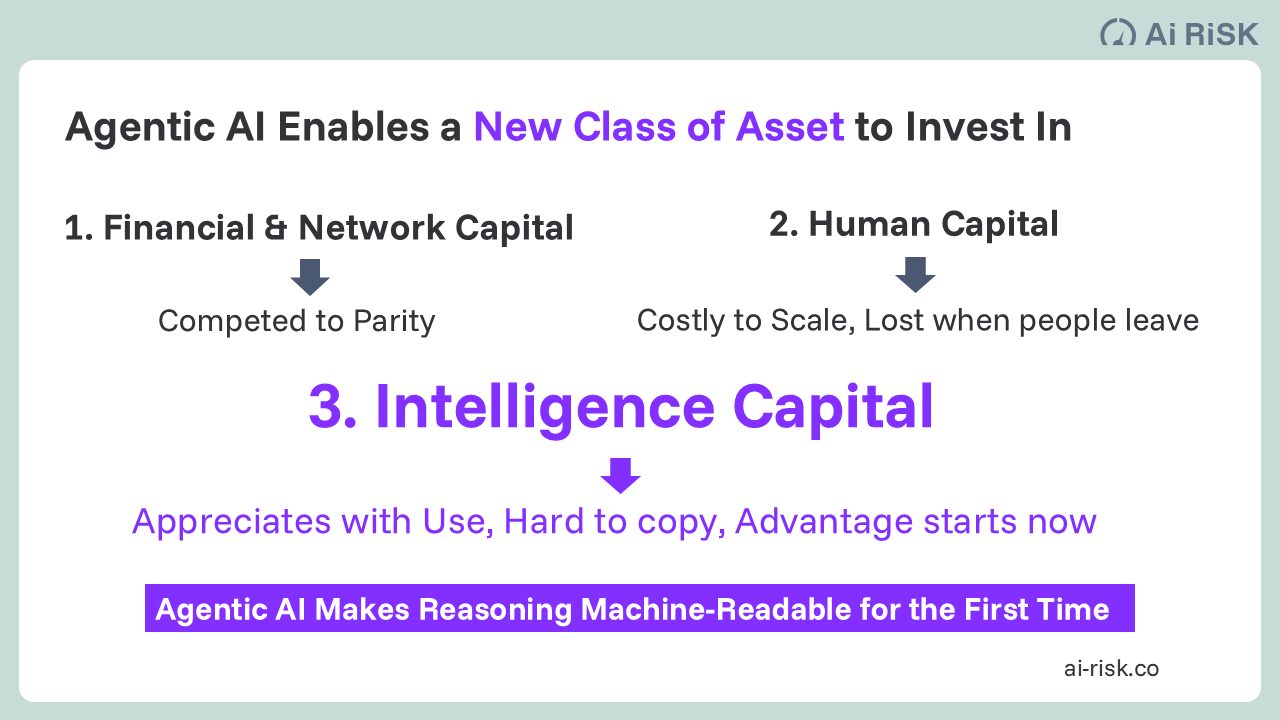
In February, in The AI Your Competitors Can't Buy, I argued that the durable prize in agentic AI is Intelligence Capital: the structured record of how your organisation reasons through its decisions, captured as the work happens, owned permanently, and improving every subsequent decision of the same type. Intelligence Capital compounds. Tools do not, because your competitors buy the same ones.
Five months of market evidence now shows most firms building the tools and none of the capital, and one test separates the two futures. If your agents' reasoning does not survive a model swap, you do not own it.
Even the most authoritative playbook stops one question short
No AI transformation method carries more authority than Microsoft's, and none is more widely followed. Its workforce transformation team studied 100 internal case studies as "customer zero", then codified what works: study each role's daily tasks and equip that role with assistants and agents; redesign processes end to end; where the prize justifies it, design AI-first ways of working from scratch. Its Corporate Vice President of Workforce Transformation, formerly Chief People Officer at McKinsey, told leaders at an event this year that the strategic results go "way beyond labor cost replacement". She is right, and the method deserves its reputation.
Every Microsoft customer receives the identical method, the identical copilots, the identical building blocks. So does every customer of every major vendor. The better a firm executes leading adoption playbooks like this, the faster it becomes agent-rich, but nothing in the playbook makes it asset-rich. The playbook never asks who owns the intelligence generated inside the redesigned processes, or whether that intelligence would survive a change of platform. The most authoritative transformation methodology on the market stops one question short of advantage.
Adoption and advantage have decoupled.
The evidence: record deployment, rented thinking
Insurance is the natural experiment, because a large part of the market's adoption can be measured. Evident's June 2026 AI Index, covering the 30 largest insurers in North America and Europe, finds productivity gains reported in 75% of the AI use cases with disclosed outcomes; revenue uplift appears in 2%. Across Evident's full map of use cases, 8% show AI improving decision quality across an end-to-end workflow.
The industry's AI activity is overwhelmingly buying efficiency anyone can buy, and barely touching the judgement that sets a firm apart. The agentic wave is arriving into exactly this pattern: agentic orchestration appeared in 25% of the market's new AI use cases in the past six months, five times its share in the six months before.
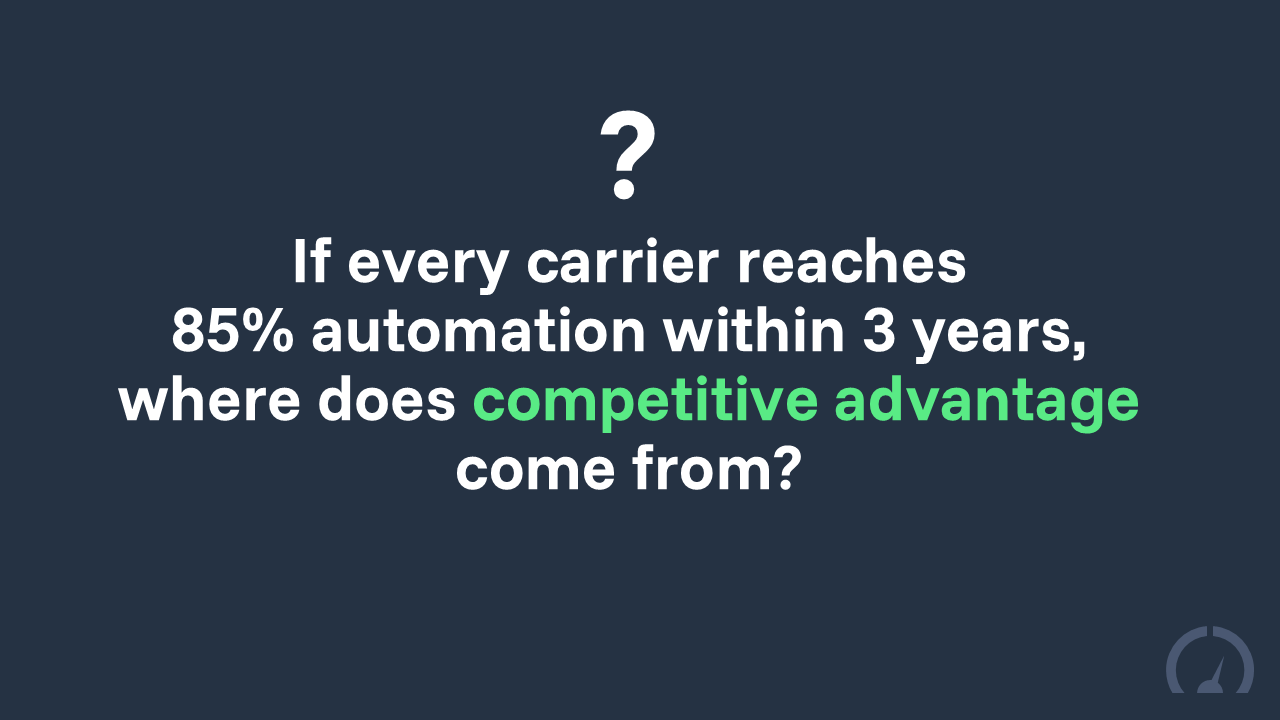
The efficiency targets themselves are converging. Chubb's December 2025 investor presentation sets what it calls "radical automation goals": 85% of major underwriting and claims processes automated and headcount down roughly 20% within three to four years, for expense savings worth about 1.5 points on the combined ratio, the industry's headline measure of underwriting profit. Carriers across the market are converging on similar targets, on similar vendor timetables. When many firms reach 85% automation together, the automation confers advantage on none of them. Our February article named this the Parity Problem: efficiency that everyone buys is efficiency that advantages no one. It has since acquired a market's worth of confirming data.
The Lloyd's market shows how fast the condition spreads. The LMA surveyed firms representing over 60% of the Lloyd's market by underwriting volume, publishing in April 2026. A year earlier, around half reported limited or no AI implementation. Twelve months on, 93% have or are building formal AI governance frameworks, and deployment remains concentrated on efficiency, with limited penetration of core underwriting, pricing and claims decisions.
AI Risk’s own commissioned scans of nine specialty carriers and the major specialty brokers, completed in June and July 2026, found the same architecture almost everywhere: decision logic resides in vendor platforms, outcomes flow to the insurer, and the reasoning stays with the vendor. In the most advanced cross-boundary arrangement in the public record, one firm's data feeds agents owned by its counterparty. At almost every firm scanned, the gap between stated ambition and production evidence is wide; the carrier with the most articulate ownership strategy on record shows the least deployment behind it.
Banking shows the same shape at higher speed: the 31% agentic share above, up from 15% the quarter before, as banks move from enterprise copilots to agents embedded in specific workflows. Deployment is compounding. Ownership is not. The pattern holds in every market where it has been measured.
The true ‘sovereignty’ test
Ownership is becoming the consensus this year: the chief executives of the largest AI vendors now urge firms to own their learning, and platform companies publish warnings about AI sovereignty. Agreement is now free, which is exactly why it is worthless as strategy. The test is what separates a firm that owns from a firm that agrees, and it needs precise statement, because most firms believe they pass the test while most do not.
An agentic system has two parts: the engine and the memory. The engine is the machinery that reasons: today, a large model and the scaffolding around it. It is rented, replaceable, and improving on the vendor's schedule; whatever you deploy today, a better engine ships within the year, to you and to every competitor simultaneously. The memory is the structured record of how your decisions were made: the evidence weighed, the alternatives considered, the confidence assigned, the expert overrides and the reasons for them.
The engine depreciates the day a better model ships. The memory appreciates with every case handled, provided it exists in structured form and lives in your environment rather than the vendor's. The memory is where Intelligence Capital accumulates. The engine is just the thing that reads it.
Multi-model access does not pass the test, though many firms will claim it does. A gateway that routes to five engines proves the replaceable part is replaceable; it says nothing about who holds the record the engines read and write. A firm can be fluent in every model on the market and own no memory. Its reasoning simply scatters across more vendors.
One rival answer deserves naming because it sounds identical and is not: the claim that institutional knowledge lives in the model's weights, distilled there by fine-tuning. Weights fail the test by construction. They are welded to the model generation that carries them, so every frontier release forces a choice between your accumulated knowledge and a better engine. A reasoning record held outside the model faces no such choice: swap the engine, keep the memory, and let the smarter model read it. Model-independence is what makes intelligence capital rather than configuration.
Almost no one has built for this. Our assessment of the major agentic platforms, from workflow orchestration suites to deliberative agent systems, conducted this year for a client architecture selection, found that none separated memory from model by default. A specialist market in portable agent memory has since begun to emerge, which confirms the gap is real; it does not change the fact that ownership never happens by accident.
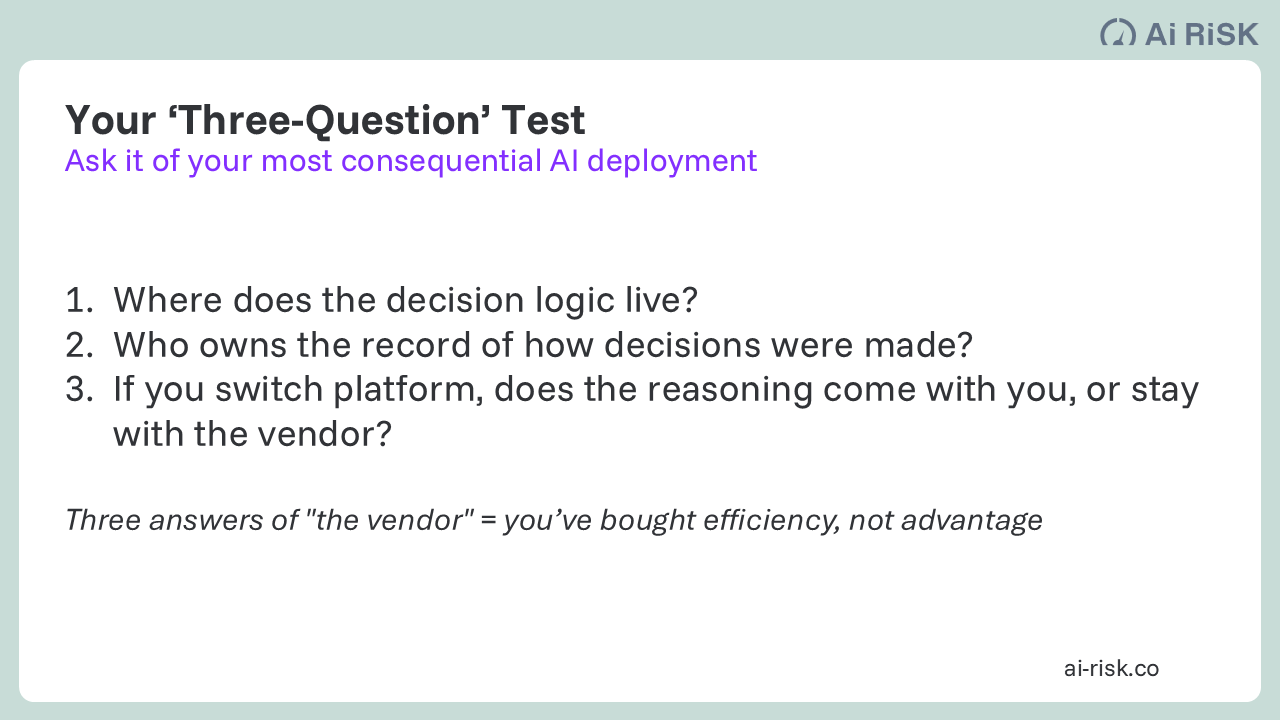
Three questions make the test practical for a board. Where does the decision logic live? Who owns the record of how decisions were made? If you switch platforms, does the reasoning come with you or stay with the vendor? Three answers of "the vendor" mean the spend has bought efficiency at the market rate, available to every rival with a budget.
Employee-built agents are an evaporation problem
The fastest-growing agent population is the one nobody buys. Enterprise platforms now let any employee build agents for their own work, and the volume projections are extraordinary: Gartner projects the average Fortune 500 firm will run over 150,000 agents by 2028, up from fewer than 15 in 2025, a figure its own analysts call a ballpark and attach to a warning about ungoverned agent sprawl.
Discount the number by an order of magnitude or two and the agent population still rivals the workforce.
The warning matters more than the count: the firm that produced the market's biggest volume projection paired it with a prediction that over 40% of agentic projects will be cancelled by 2027 for poor governance and unclear value. Firms report the builder counts as an innovation metric: a thousand builders, a thousand agents, rising engagement. Microsoft's workforce lead argues, correctly, that work can only be reinvented by the people who do it. Followed one step further, her insight identifies the problem. When an employee encodes their judgement into a personal agent and nothing captures the reasoning in a governed, organisation-owned record, that judgement leaves when they do, at machine speed and without a leaving party. The firm celebrates a thousand builders and owns nothing they built.
Expertise has always walked out of the door at retirement. Ungoverned agent proliferation industrialises the exit.
What ownership looks like
The distinction that matters is between input assets and output assets.
Input assets are assembled in advance: prompts, playbooks, codified knowledge, fine-tuned configurations. They are useful, purchasable, and depreciating, because every competitor can assemble equivalents from the same vendors. Proprietary data belongs on the input side of the ledger too: it records what happened, where a reasoning record captures why the organisation decided.
The difference is the football match score and the match film (including commentary and after-match interviews). The score tells you what happened. The film shows you why, and only the film improves the next match. Output assets are generated in operation: the reasoning records, deliberation histories and captured overrides that accumulate only through owned architecture and elapsed time. Elapsed time cannot be bought, which is why Intelligence Capital is the only AI asset class a late-moving competitor cannot close the gap on by writing a cheque.
The compounding mechanism needs no leap of faith, because humans have run it for centuries wherever reasoning was written down. Common law compounds precedent: every judgment recorded improves the next ruling. Underwriting guidelines are claims experience compounded into selection discipline. Apprenticeship compounds judgement person by person, at the speed of conversation.
The reuse effect has now been measured. In the largest field study of its kind, published in the Quarterly Journal of Economics in 2025 from a deployment that predates today's models by two technology generations, a customer support operation of roughly 5,172 human agents was given an AI assistant trained on the recorded decisions of its best performers: average productivity rose 15%, the least experienced staff improved by around 35%, and workers with two months' tenure performed like workers with six. The engine was primitive by current standards, which sharpens the finding: the gains came from the record, not the model. One reasoning record, captured once, moved an entire workforce down the experience curve.
Agentic AI changes the economics of the mechanism: for the first time, the record builds automatically, at the point of work, on every case. Whether reasoning records compound is settled by centuries of practice. Whether firms will build them is the open question, and nobody holds proof at scale, because generating the proof requires doing the thing. That is the first-mover argument in its purest form: the first accumulator will own both the asset and the evidence.
Ownership is an architectural property, and it is available at every level of ambition. Workflow orchestration deployed with ownership designed in generates procedural intelligence the firm keeps. Ownership designed in means the platform contract says three things plainly:
the firm receives the reasoning behind every automated decision, in structured form; the firm holds it in its own environment, and the vendor keeps no exclusive copy; and if the firm leaves the platform, the record leaves with it.
The same orchestration deployed without those terms generates the Parity Problem with better tooling. Deliberative agent teams working on the hardest cases are built to generate the compounding form: reasoning deep enough that the 200th similar case is handled better than the 50th. That is what the architecture is designed to deliver, and its measurement is only now beginning.
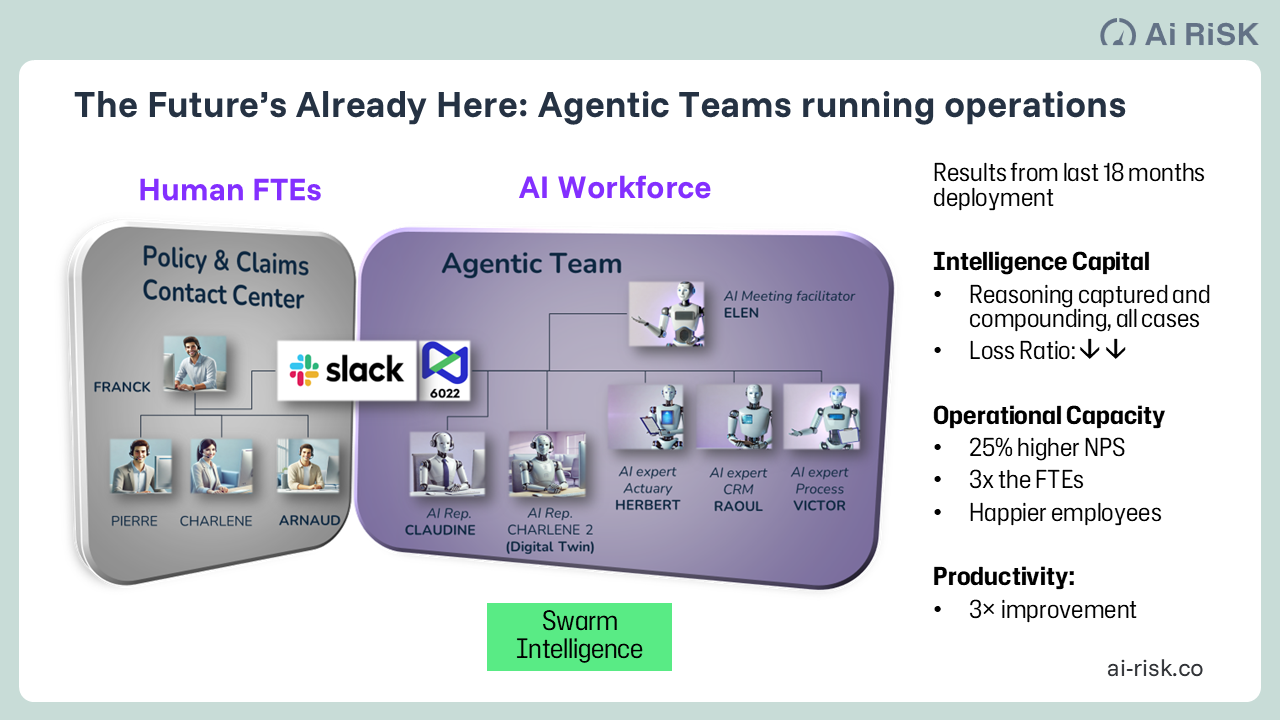
In one of the most advanced production deployments our team worked on, agentic teams have run policy and claims operations with reasoning captured on every case, at production scale, for over 18 months; that record generated improvement evidence from the start as well as other powerful commercial benefits (see case study here).
What binds these levels into one asset is a single governed memory that every agent writes to and reads from: reasoning captured at the point of work, structured to one standard, governed by one set of authority thresholds and audit rules, held in the firm's own environment.
That memory, and the control logic that governs what every agent may decide, form the owned core of what we call the Coordination Layer: the tier of the enterprise where all your agents operate, between the people they serve and the systems they act on. The agents, orchestration tools and models inside the layer are bought, rented and replaced as better ones ship.
The Coordination Layer is built once and owned outright, and no major platform provides it by default, because the vendors' commercial interest points the other way: your reasoning inside their platform is their moat. The core of the Coordination Layer is the one part of the agentic stack where building, not buying, is the strategy.
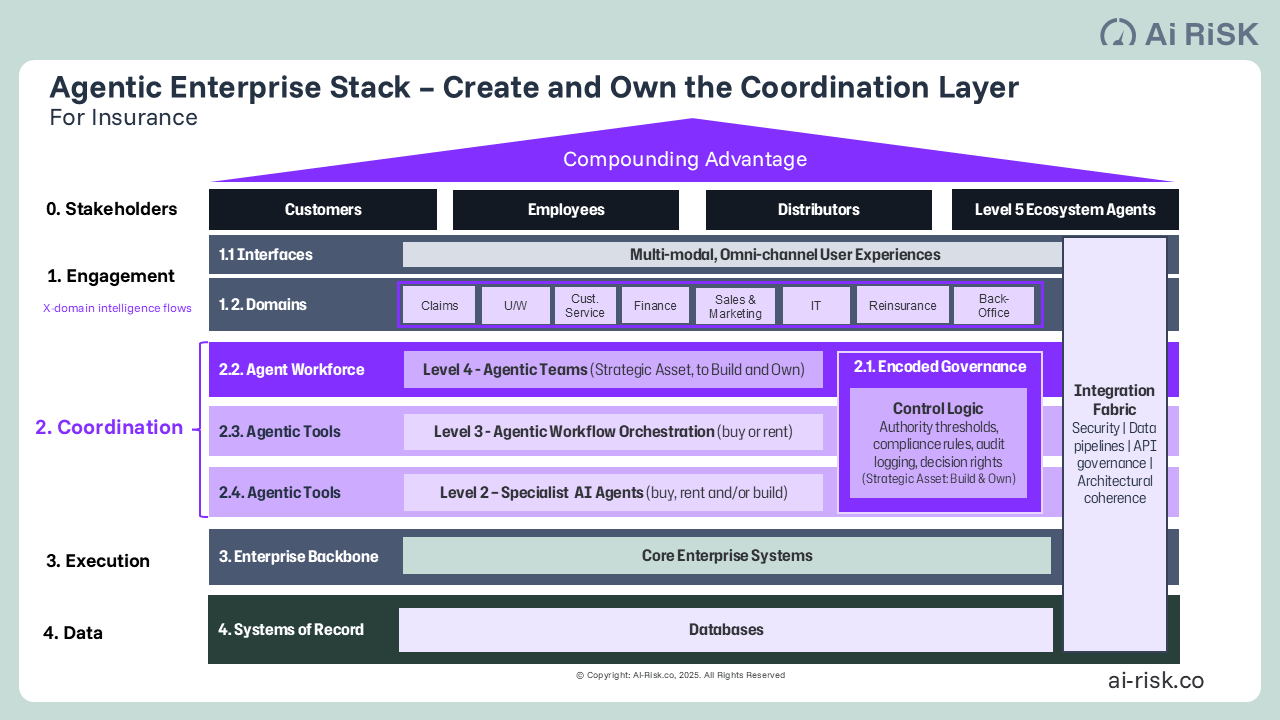
Example of how the Coordination Layer is applied to an insurance carrier (Source: AI Risk)
Fast-Follower in agentic AI is the Worst Strategy
The economics answer the question every finance director will ask. Efficiency gains fund the programme: automation releases the capacity to handle more decisions without proportional hiring. Decision volume makes the reasoning worth accumulating, and accumulated reasoning improves the decisions themselves. In insurance terms, for example: savings on the cost of running the business pay for the build, while improvements in the quality of risks selected and claims settled, the loss ratio, are the larger and more durable prize that compounds from it. So we advise companies to run efficiency and intelligence together from day one. Sequencing them, efficiency now and intelligence later, is the fast-follower strategy, and it fails for one simple reason: the compounding time forgone can never be bought back.
The fast-follower position is deteriorating in the survey data too. In McKinsey's April 2026 global survey of 1,205 executives, 60% expect AI to differentiate their organisation from competitors, which cannot be true of most of them when most are buying the same tools; and nearly 60% of the slowest movers expect their business model to require significant change within three years just to remain viable, against 40% of respondents overall.
For conventional technology, fast following worked: let others fund the mistakes, then buy version three cheaper. For agentic AI the logic inverts, because the asset is the record accumulated by operating, and the record cannot be bought at any version. First to adopt confers nothing. First to accumulate confers an advantage that compounds for every month the followers wait.
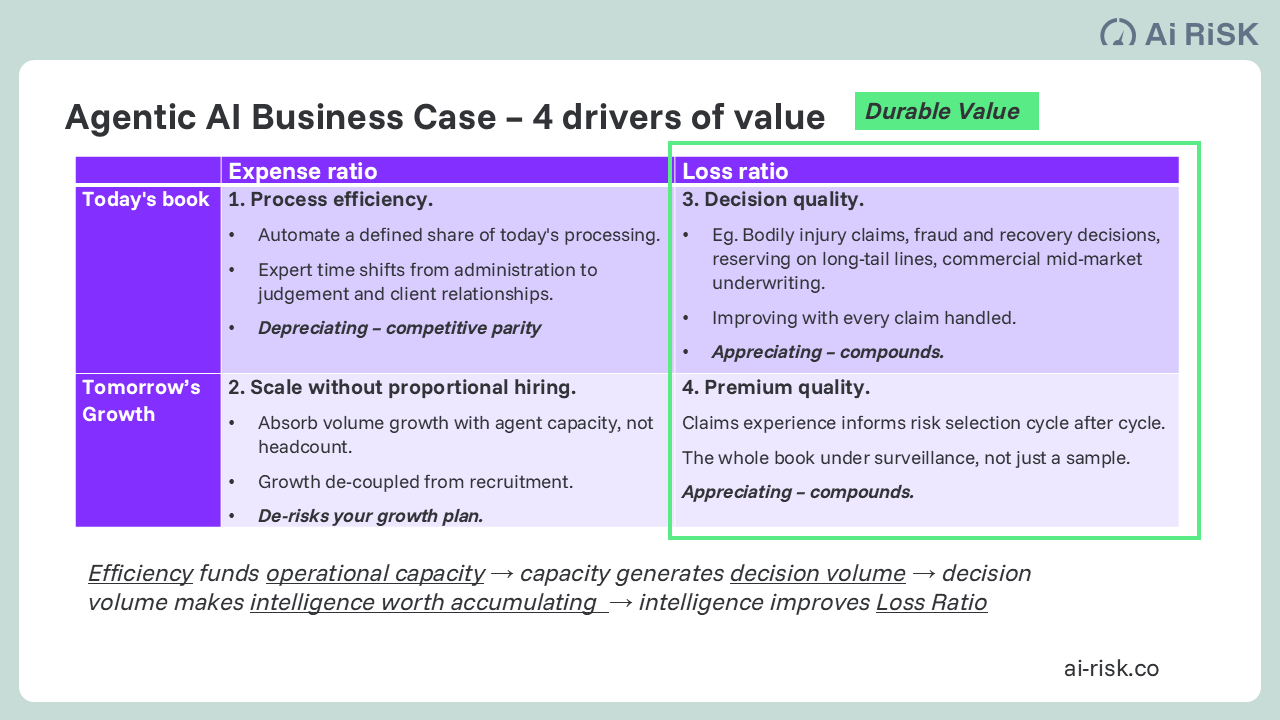
Example of how to think about ROI from Agentic AI strategically - insurance industry example (Source: AI Risk)
The measurement discipline follows directly. Stop counting licences, pilots and agents deployed. Count the proportion of significant AI-assisted decisions that leave a structured, owned, reusable reasoning record. That proportion is your Intelligence Capital accumulation rate, the speed at which the organisation learns in a form it owns, and today, in most firms, it is effectively zero.
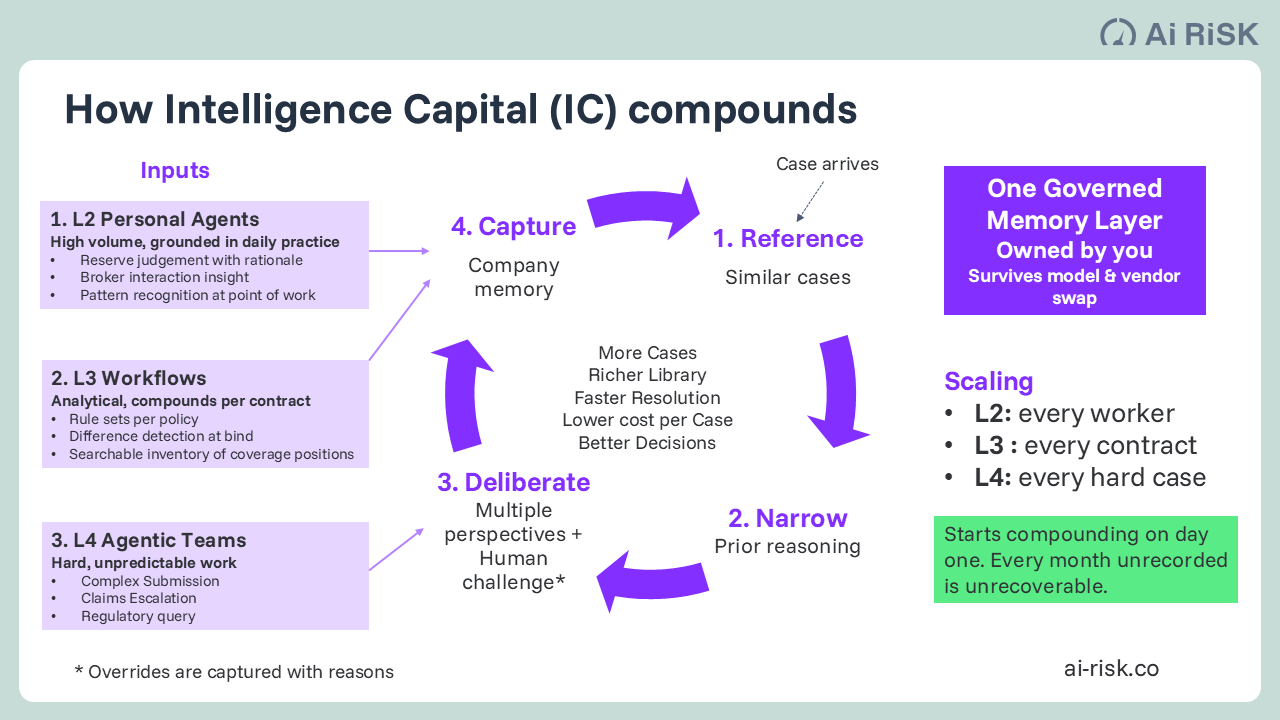
Example of how Intelligence Capital compounds in Insurance with the appropriate approach to Agentic AI (Source: AI Risk)
The workforce arithmetic sets the clock. Take an illustrative mid-size insurer with 3,000 employees, built on published German industry ratios: 740 people, drawn disproportionately from the most experienced quartile, are due to retire by 2031. In the ‘drift’ future, the firm replaces roughly half of them, accumulates a few hundred uncoordinated AI agent-equivalents, and decades of judgement leave with the people.
In the ‘designed’ future, the same demography applies, but every decision the 740 make between now and their retirement adds to a record the organisation owns, and the record improves the next decision. Headcount is roughly identical in both futures. Strategy decides whether capability shrinks with the workforce or compounds beyond it.
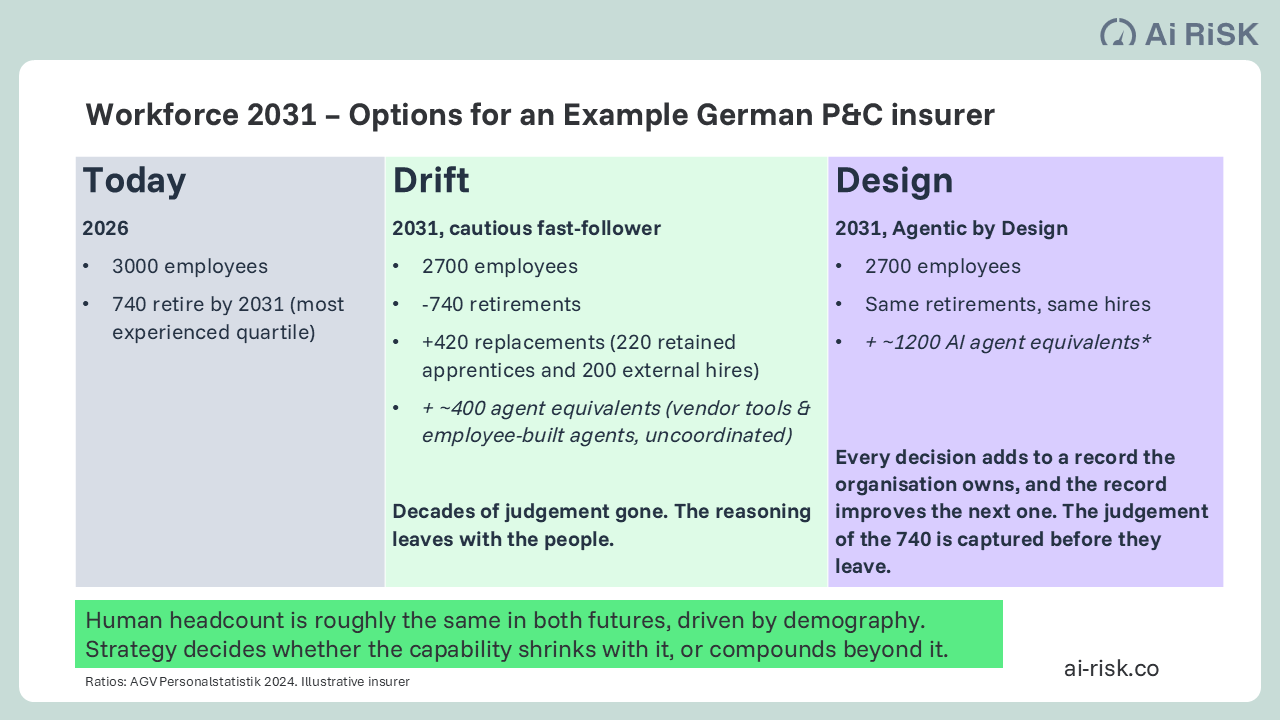
There are many different hybrid workforce scenarios for different types of company. A strategy for defining and implementing that future is critical now to compete in the age of AI. Our Accelerator method help companies quickly define and align on this.
Two 2031s
Both futures cost roughly the same to reach. Both involve heavy adoption, agent populations rivalling the workforce, and near-identical headcount. In one, five years of operational reasoning belongs to your vendors and your former employees. In the other, five years of Intelligence Capital belongs to you, and it has been improving your decisions the entire time. Neither future is preordained. The choice between them is architectural, it is available now, and it narrows with every unrecorded month.
So apply the test this week. List your ten most consequential AI deployments and ask of each: if we swapped the model tomorrow, what would we still hold? Then ask the harder question, the one no vendor's playbook will put to you. When the transformation is complete, what will you own that a competitor running the same playbook does not?