Consumer AI Agents Have Arrived…And They Won't Stop at Research
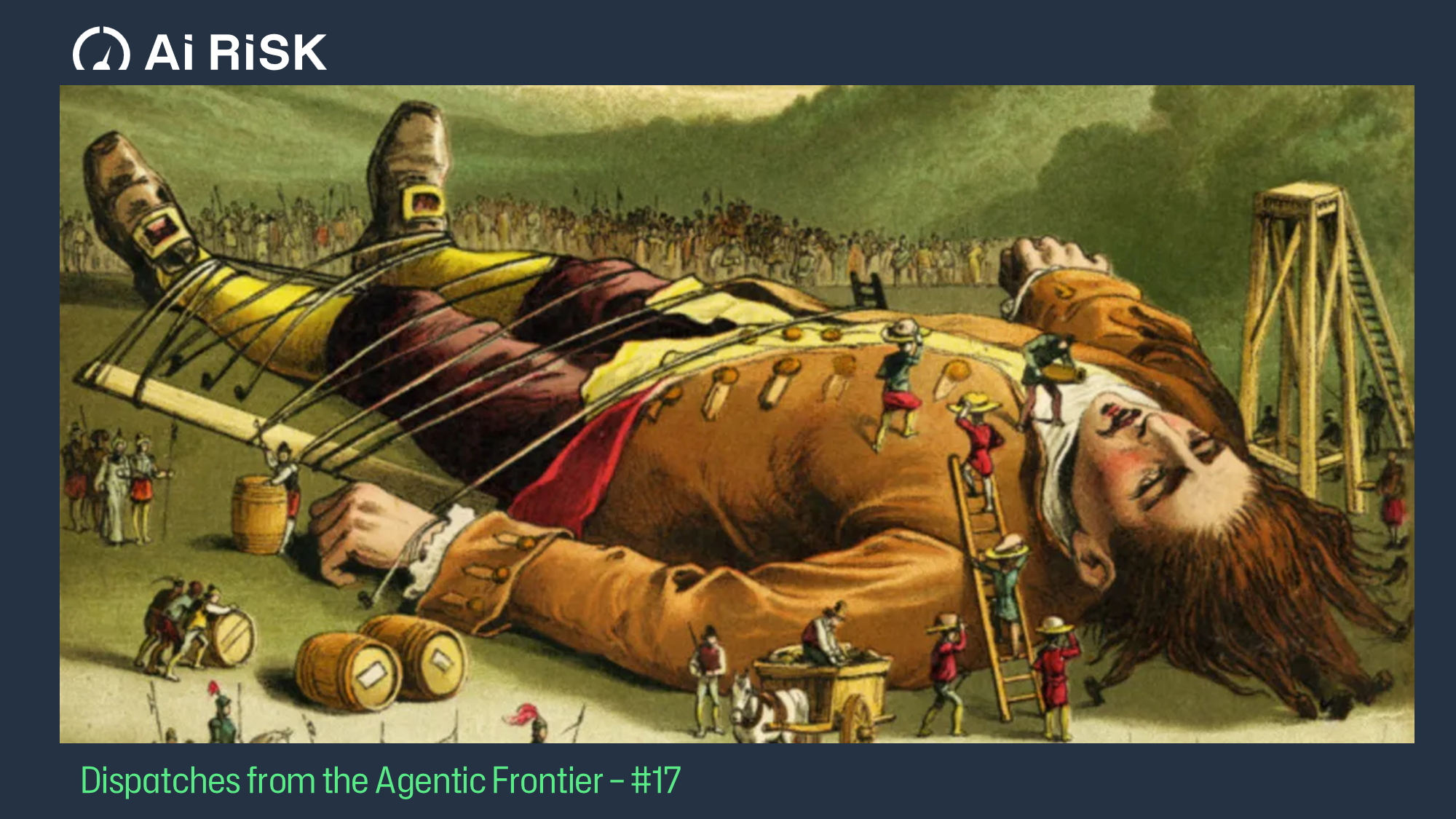
Gulliver tied up by the Lilliputians, from Gulliver’s Travels: Coloured Picture Book for the Nursery (Thomas Nelson and Sons, 1883). Public domain, via Wikimedia Commons.
Dispatches from the Agentic Frontier is a regular intelligence briefing for leaders in knowledge-intensive sectors. Each dispatch translates evidence from the frontier of Agentic AI – practitioner experience, investor signals, strategy research, market events – into what it means for enterprise leaders building for competitive advantage. All are filtered through the Intelligence Capital framework developed in The AI Your Competitors Can't Buy.
In Brief
Customers are starting to use new AI agents - like Muse, Instinct, Dots and Grok Bot - that act for them with their bank, their energy and phone providers, and their insurer. It’s still early days, but every service organisation will meet many, many more of them from next year onwards, creating the threat of ‘agentic flooding’: more requests, better argued, landing on operations and compliance as well as marketing and sales.
In this article we take insurance as the worked example of what is likely to happen, and why and how service providers should prepare to respond now.
Consumer AI agents will increasingly compare insurance cover, switch insurer, change policies and file claims, wearing away the customer inertia that much of the margin rests on. Making your information readable by AI agents is necessary but insufficient. You need AI agents of your own to meet the customer’s, with clear limits on what they may agree to and reasons kept for every answer. We propose three lines of agentic engagement, and the key questions to ask before building any solutions.
What is changing
Instinct, a new type of AI agent that acts for me, recently sorted out two supplier problems. It sent my elderly mother's broadband provider a formal complaint citing the regulator Ofcom’s rules, followed up persistently on its own, and the matter was settled saving her hundreds of pounds. When my new car developed a charging fault, my personal agent dealt with the dealer by email, brought the repair forward from months to days and secured me a courtesy car.
An AI chat platform (like Claude, ChatGPT or Gemini) would have told me what to write. Instinct wrote it, sent it, tracked the replies, followed up, and kept every detail. I was delighted with the experience: it saved me a lot of time and frustration. I’ll be using Instinct for shopping, travel, financial services and insurance next.
Agentic commerce - which we explored in detail in April - means AI doing some of a customer's buying and dealing with suppliers on their behalf. It is reaching insurance in two forms that are easy to confuse. The first is familiar. People already ask AI chat platforms which insurance to buy. A third of consumers in a 15-market survey this year said AI is where they now start shopping.
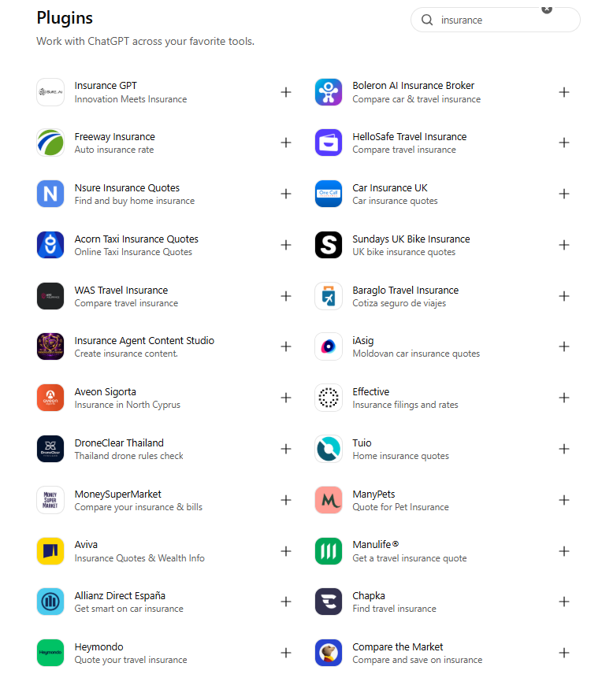
Insurers can publish apps (‘plug-ins’) inside these platforms to be found and quoted within the conversation. Very few have. As of this month OpenAI's app directory holds 25 insurance apps, 22 of them selling or comparing cover. Against about 4,900 insurers in Europe and nearly 6,000 in the US, that's roughly 0.2%, before MGAs and brokers are counted. Rivals copy this kind of presence within months: Go.Compare followed MoneySuperMarket into ChatGPT three months later.
The second is newer and matters more.
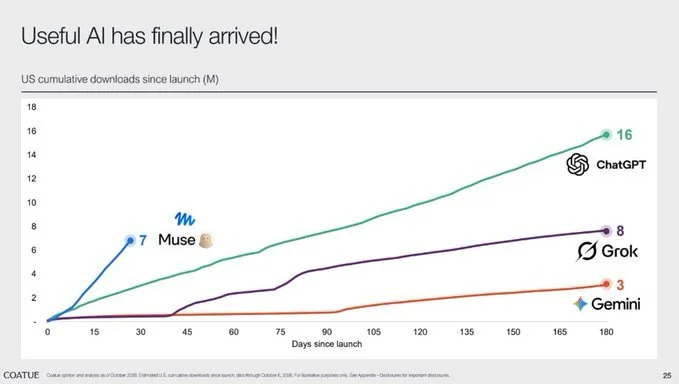
A Consumer AI Agent, as my personal example demonstrated, is software that acts for a customer rather than just answering their questions. It holds their accounts, follows their instructions and keeps working while they're elsewhere, so it can compare quotes, buy a policy, cancel the old one and chase a claim. Meta's Muse, launched in the US in September, is the best-known example; Instinct, Open AI’s Dots and Grok Bot are others. Muse passed 5.1 million US downloads in its first 22 days, more than twice ChatGPT's 2.3 million over the same period, helped by heavy advertising from Meta. That is still about one American in 70, and a download is not an active user.
Both forms - AI Chat Platform plug-ins and Consumer AI Agents - are types of Agentic AI, which we define as AI systems that carry out work themselves, rather than drafting something for a person to act on.
The early cases already go beyond researching product options. In September Forbes reported a Muse user who had Muse replace his GEICO motor policy at about $1,000 a year less and cancel the old one. Another used Instinct to recover about $2,000 from old car and health plans, with Instinct filing the claims itself. Both are single reported cases, not measured trends. When an Instinct user tried to get a GEICO quote online, the site failed twice and sent it to a phone number.
Why this matters
As their value and ease of use becomes apparent Consumer AI Agents will increasingly deal with insurers across the whole customer relationship. Four reasons make it an executive matter.
Operational impact. Being found on a chat platform is only the first moment of the relationship, and the only one a tiny number of prepared insurers have worked on yet. Everything after it lands on operations, claims and compliance. No enterprise is ready for the full impact of this.
Consumer AI Agents remove the inertia insurance economics depend on. A good part of insurance margin rests on customers finding it too much effort to compare, switch, change cover and complain. A Consumer AI Agent doesn't tire of comparing. The UK regulator measured one part of what that inertia was worth: about £1.2bn in a single year from apathetic home and motor customers.
‘Agentic flooding’ has already begun elsewhere. Agentic flooding is a surge in the volume or complexity of requests, driven by AI, that strains the service handling them. A study of 12 countries found 84 such cases in public services, with benefits and complaints among the most affected. It collected only positive cases, so it shows the pattern exists, not how common it is.
Insurance has already had a preview, though not from Consumer AI Agents. US health insurers pay hospitals according to the codes on each bill, which record what was wrong with the patient and what was done. More codes, or more serious ones, mean a bigger payment. Hospitals now use AI tools that read the medical notes and find every code that can be billed. The Blue Cross Blue Shield Association estimates this added about $942m to its member insurers’ costs over 2023–25, for the same care. Hospitals say the tools simply make records complete, and they may be right. But, either way, the insurers paid more because the other side used AI to work the rules harder, not because patients were sicker. Consumer AI Agents can do the same for every policyholder’s claim.
Picture Gulliver in Lilliput. Each customer’s AI agent is one thread: a claim chased, a complaint escalated, a renewal shopped. None is a problem on its own. Thousands at once can pin down a firm many times their size.
Others are already setting the terms. Amazon blocked Muse in September as an unauthorised AI agent. On 13 October JPMorgan said it won't let outside AI agents operate in customer accounts. Jamie Dimon, its chief executive, told customers who use them that the risk moves to them: "There's a liability transfer." In insurance, Sigo Seguros opened its US motor quoting to Consumer AI Agents on 1 October but stopped them before they could choose a policy, pay or issue cover.
Lemonade has gone furthest the other way. It has announced an experience built for customers' AI agents, letting them quote, buy, change, claim and cancel directly in its systems. It isn't live yet, but it describes no limits on what those AI agents may do. Each is a decision about what an outside AI agent may do. Most insurers haven't made their decisions yet, which are the cheapest to make now, before the volume arrives.
Flood or Flywheel?
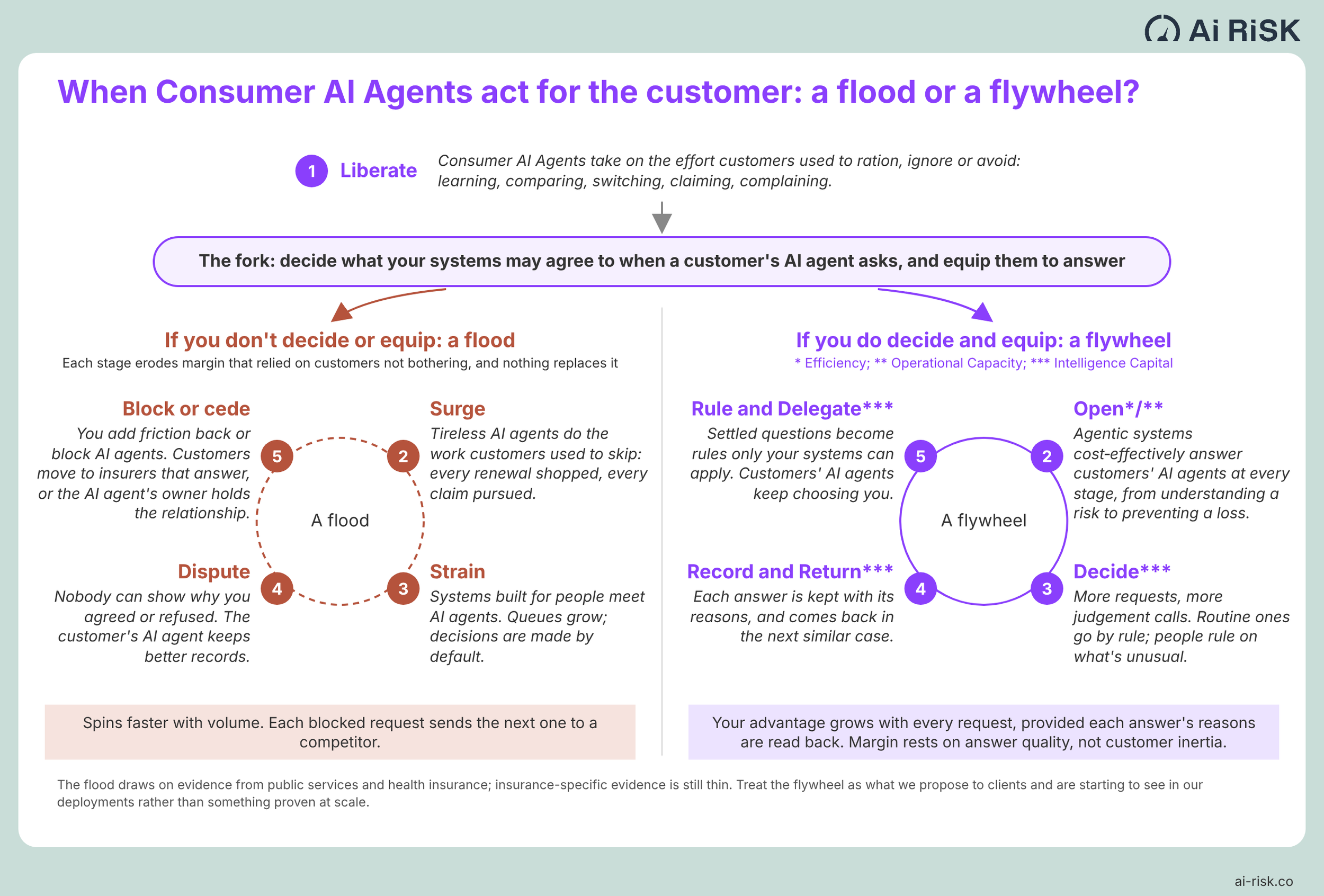
The left side of the diagram above is what happens to insurers that wait. The rest of this article is about the right side: what it takes to decide and equip, and what an insurer gains by doing so. In short, we propose three lines of agentic engagement, set out below.
The two changes need different owners
Presence on AI chat platforms is necessary, but it's a channel question, and something our April article called a parity investment (everyone can and will do it). The emergence of Consumer AI Agents presents a different change: a new kind of customer representative that stays with the customer after the purchase and meets the insurer at every point of contact. The channel question belongs to distribution and marketing. The representative question belongs to operations, claims and compliance. In most insurers neither has an owner for these topics yet.
A representative across the whole relationship
An insurance policy is one product in a longer relationship. The representative change that Consumer AI Agents bring reaches every stage of it, per the diagram below.
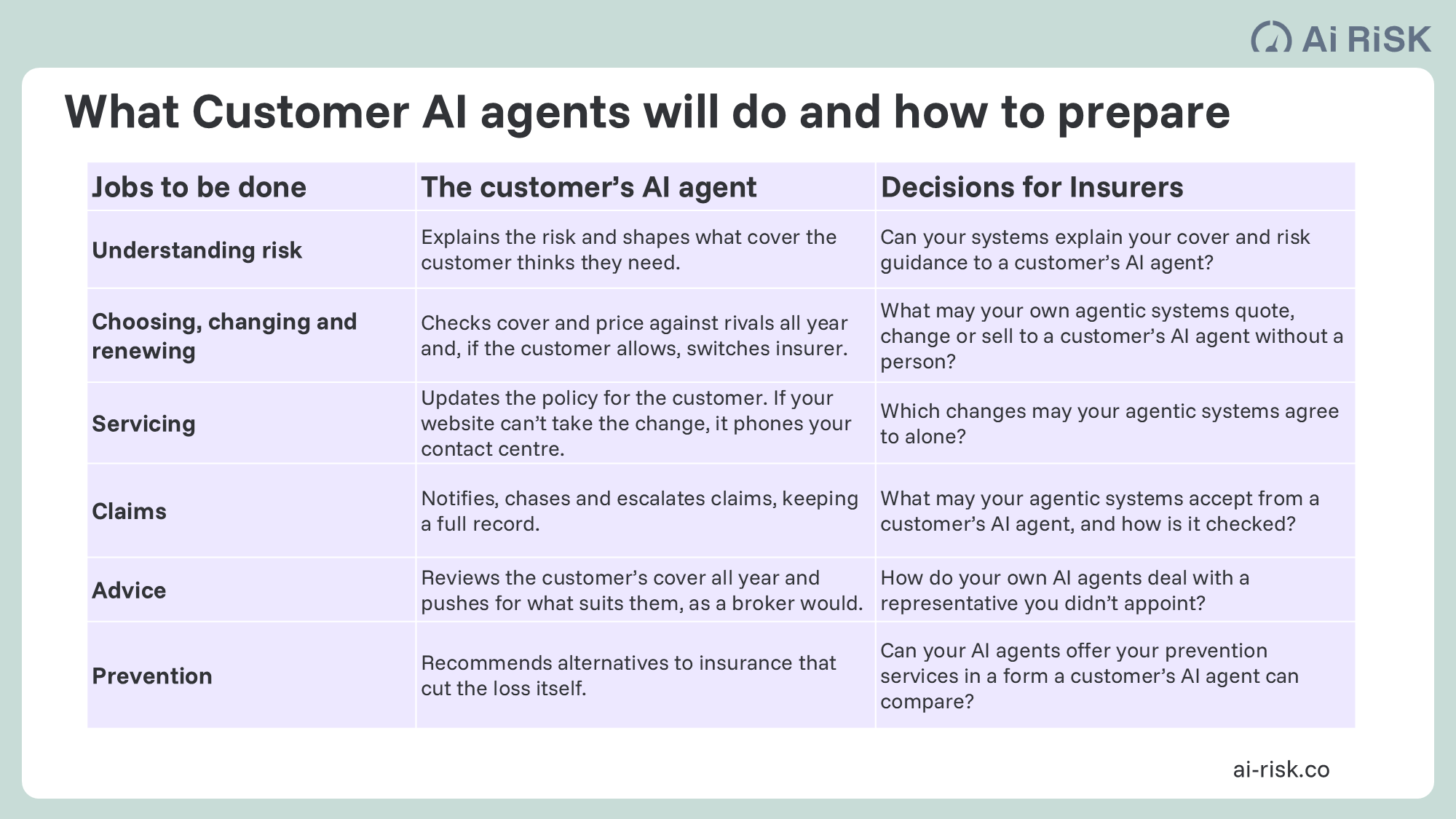
1.) Understanding the risk. In the same 15-market survey from earlier this year, 42% of people who shop with AI said they usually start by describing a need, against 33% who start with a brand. In insurance the need is a risk the customer may only half understand, so the AI agent that explains it shapes what cover they think they need before any insurer is named. That could help to increase consumption of insurance products and reduce protection gaps. A Consumer AI Agent told only to cut monthly spending could widen the gap.
2.) Choosing, changing and renewing cover. Consumer AI Agents make comparison continuous. In the same survey, 60% said they'd consider switching from their usual provider if an AI agent found a better fit. The authors name insurance renewal as the obvious case. These are stated intentions, not behaviour. Our team’s own test this month for a client, anonymised here, sent a Consumer AI Agent and an AI chat platform to a UK broker and two direct insurers. Both recommended the broker in its specialist line, but its website could take nothing from the AI agent beyond the customer's name. Both direct insurers stopped the AI agent before showing a price.
3.) Servicing. An AI agent that can't complete a change on the website ends up on the phone, as Instinct did at GEICO. An insurer whose site can't serve AI agents will meet them - or their frustrated human owner - in the contact centre, at human cost.
4.) Claims. Consumer AI Agents already notify and chase claims. Whether they raise claim frequency in personal lines is still open: half of US motor and home policyholders say they've skipped an eligible claim, mostly for fear of a higher premium, not because claiming was hard, according to an August 2026 survey of 2000 consumers. The health-insurance evidence above shows the other side: when AI works on the claimant's side, costs can rise with no change in the underlying risk.
Field notes: Monsieur K
Months before Muse and Instinct existed, my colleague, Arnaud Vincent, built his own personal AI Agent, Monsieur K, with the open-source Hermes framework on a proprietary blockchain protocol. In addition to helping Arnaud run his daily operations, his agent was given a written mandate to handle his consumer disputes. Since May it has handled three, entirely in writing.
A telecom billing dispute, won in the operator's web chat after four redirections to a phone line. The fees were cancelled and the contract later ended.
A product warranty claim, won by email: a replacement worth about €1,000, delivered.
A travel-insurance claim for one hotel night, about €130, after a delayed flight caused a missed connection. The insurer refused. Monsieur K sent more than 18 emails, built a six-point argument from the policy wording, obtained the airline's written confirmation of the delay, and prepared a 13-page dossier for the insurance ombudsman. Since late September the insurer has replied only with automatic acknowledgements. The case is still open.
Two things stand out. Monsieur K stopped at every irreversible step (signatures, payments, live calls) and showed its owner every sensitive message before sending it. That's the kind of mandate an Agent Access Charter should expect (we’ll come on to this concept later). And the insurer met a tireless, well-documented claimant over €130 with form replies. This is the left-hand side of our Flood or Flywheel diagram, in miniature.
Arnaud has a PhD in AI, 30 years experience as a tech innovator and entrepreneur and is one of the world’s leading experts on agentic AI. He knows how to build a personal agent using the most cutting-edge technology. Now anyone can have their own personal agent. Next year every service provider will feel them knocking at their doors.
5.) Advice. A Consumer AI Agent that watches a customer's cover all year competes with the traditional human adviser. Sangeet Paul Choudary, one of my favourite analysts, argues this month in the Harvard Business Review, that the prize AI agents are competing for is the right to represent the customer. In advised UK and US insurance personal lines, the independent broker already holds that right. Where banks and tied agents sell much of the cover, as in many Continental European markets, the person at the counter represents the insurer. There the Consumer AI Agent may be the first representative the customer has had of their own.
6.) Prevention. A Consumer AI Agent asked to deal with a customer's risks won't stop at insurance. It may conclude that a leak sensor or a flood barrier does more for the customer than a higher policy limit. For small businesses, cyber security monitoring is an equivalent. This could be good for all parties. Fewer losses improve the insurer's loss ratio, and a lower expected loss can bring cover within reach of customers priced out of it. An insurer whose prevention services an AI agent can read and compare gives the agent a reason to recommend more than its price.
Every stage above removes customer effort that insurance economics have relied on. That effort earns insurers money in two ways. Customers who don’t shop around pay more at renewal, which is margin. Customers who don’t query, complain or claim cost less to serve and are paid less, which is cost.
We can call the two together the friction dividend.
Michael Hallsworth, of the Behavioural Insights Team at NESTA, makes the wider point that friction has always quietly rationed access to services, favouring "those who have time, patience, lawyers or all three". That makes it a poor thing to defend. Below I propose what should replace it.
What the friction dividend is worth
The friction dividend is large where it has been measured. Nobody has yet measured what Consumer AI Agents do to it. In 2018 the Financial Conduct Authority, the UK regulator, found that about 6 million UK home and motor customers could together have saved about £200 each by paying the average price for their risk. From 2022 it banned charging renewing customers more than new ones. Its own evaluation found the practice reduced, but not eliminated. Ireland has a similar ban. EIOPA, the EU insurance supervisor, told national supervisors to police unfair differential pricing but stopped short of a ban.
So in most markets, a Consumer AI Agent at renewal can still find that margin.
Costs are the other pool. US private motor insurers spend about 31% of premium on selling, general expenses and handling claims, or about $310m a year on a $1bn book. The diagram below shows how much of that would pass through AI-agent journeys if Consumer AI Agents handled 1%, 5% or 15% of customer interactions. These are illustrations, not forecasts.
Even the middle case matters. At 5%, about $16m of costs, or 1.6 points of combined ratio (claims and costs as a share of premium), would run through journeys whose cost depends on how well the insurer has prepared. Insurers compete over single points. Served machine to machine, those journeys should cost less than human ones. Pushed to the phone, they cost more, because the contact centre now handles work customers once couldn’t be bothered to start.
No insurer has disclosed how many quotes, cancellations or claims AI agents are currently generating because they are, of course, beyond tiny at this stage. But that's precisely the reason to start counting now, while the numbers are small enough to learn from.
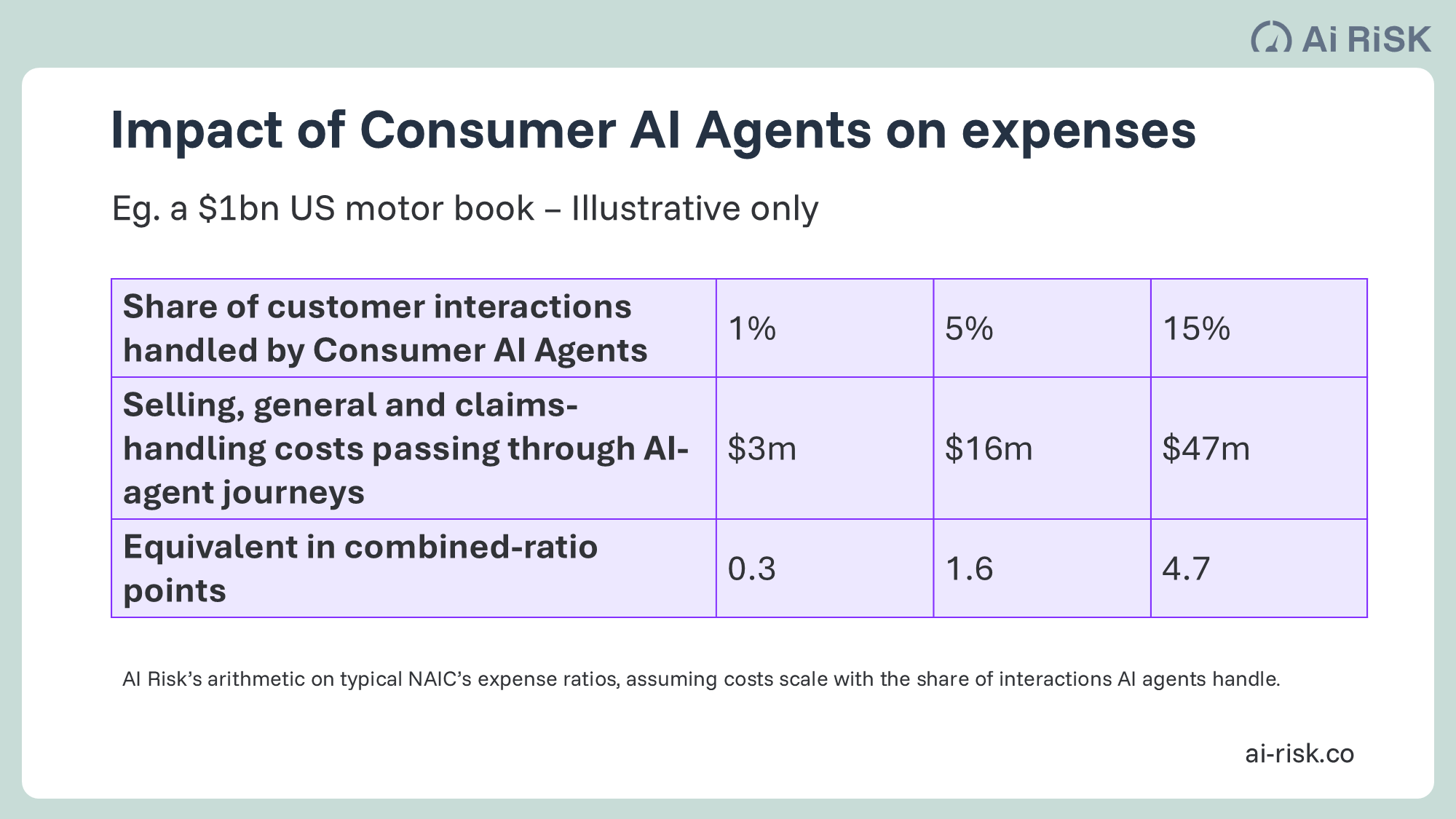
Note: This is the cost side only. It leaves out the renewal margin at stake, the claims customers’ AI agents may pursue, and the gain from being the insurer those AI agents choose.
The lasting advantage sits on the insurer's side of the conversation
Sangeet Choudary also observes that buyers are getting AI agents faster than sellers, and that markets change once sellers have them too. In insurance the seller's side of each conversation is a judgement. Quoting standard personal motor is mostly rules, settled in advance. The judgement sits in referrals, exceptions, advised lines, unusual servicing requests and claims. Its verdict often arrives years later. Nobody can experiment their way to a better answer on decisions graded that slowly, including your competitors.
That makes decision rights the central question. What should we allow a Consumer AI Agent to do: quote, select, pay, bind, change, renew, cancel, claim? What should your own systems agree to in return, without a person? Sigo answered the first question in public, as we saw earlier. Each insurer will have to answer both questions, product by product and stage by stage.
Accountability stays with the insurer
AI agents make mistakes: Business Insider reported Instinct inventing documents. Meta's checkout protections for Muse cover eligible purchases, but nothing in them covers a cancelled policy or a wrongly filed claim. Regulators are placing the responsibility with firms. The chair of the US Federal Trade Commission has said responsibility follows whoever instructs an AI agent. The UK’s FCA expects the Consumer Duty to apply while it adapts the rules.
Disputes will turn on evidence: which AI agent acted, for which customer, with what authority, what it was shown and what was decided and why.
A log of every conversation answers the dispute. As I set out in August, the same material, kept as the reasons for each decision and read back when the next similar case arrives, lets the insurer decide that case better. That kept material is the Reasoning Record. And the Reasoning Record is where Intelligence Capital accumulates.
What grows is the share of AI-agent requests your systems can answer at expert standard with no expert present. Each referral decided and recorded with its reasons can become a rule your systems apply alone next time, which frees experts for the cases still beyond that line.
The effect holds only if the reasons are read back at the next decision and only where enough similar cases arrive for patterns to show. This creates a durable advantage: a competitor can buy the same technology for dealing with customers’ AI agents, but it can't obtain your record, because the record is made of decisions your firm has already taken on its own customers, in time that has already passed.
Three lines of agentic engagement
Making your information readable by AI agents is necessary, whether through an app on an AI chat platform or a website rebuilt for AI agents. And many are racing to do this. But it isn't enough once every customer has an AI agent of its own, because that AI agent needs someone, or something, on the insurer's side who can act. We are proposing to our clients that insurers meet customers' AI agents with AI agents of their own, in three lines of agentic engagement.
Welcome. The first line greets each customer's AI agent, works out what it needs and answers basic questions. It's a far more capable descendant of today's chatbot. Anything more goes to the second line.
Concierge. The second line becomes the single point of contact between the customer's AI agent and the whole insurer. It holds the conversation and brings in whichever experts the request needs. (We have some tried and tested methods for managing LLM token costs here).
Experts. The third line is many specialist AI agents across underwriting, servicing, claims and every other function, reaching the insurer's data and systems through governed connections built on the Model Context Protocol (MCP). They work in different ways depending on the problem. Some manage a workflow, some compete to find the best answer, some divide up the ground, and some argue a contested case to a position, as our Dispatch on agentic swarms described in detail. Unusual cases go to people. We have deep experience of managing multi-agent systems at scale.
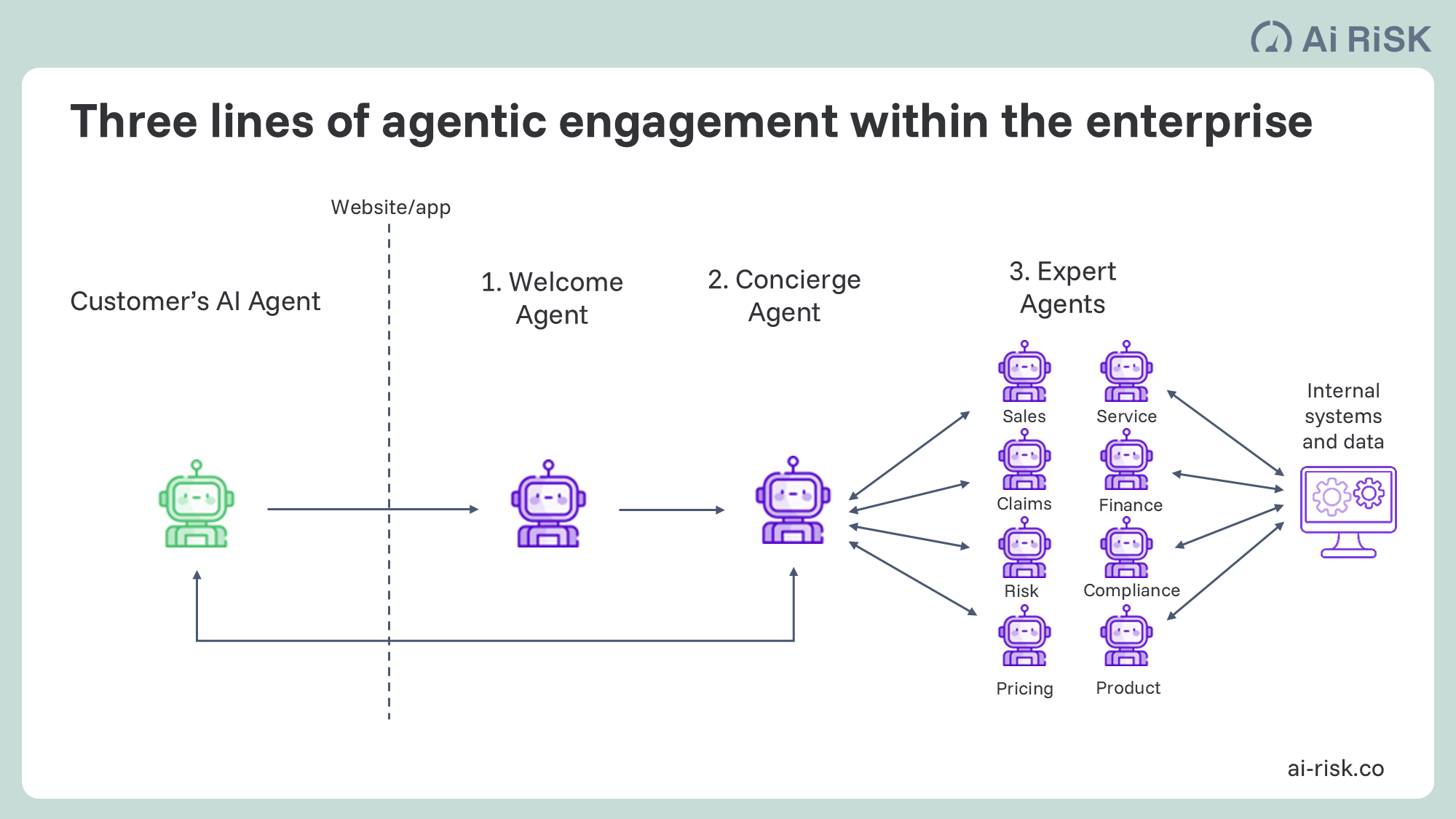
This is where the flywheel from our earlier diagram turns. The concierge automatically records each answer with its reasons into institutional memory. When a question is settled, its answer moves down a line: what needed experts becomes something the concierge can answer, and what needed the concierge becomes something the welcome line can answer.
How the two sides (customer agent and internal agent) connect changes at purchase. Before a customer buys, the two sides talk over open standards. Agent2Agent (A2A), a protocol started by Google and now governed by the Linux Foundation, can be used to let AI agents find each other and hand over tasks. The draft Personal Agent Protocol can be used to add sign-in, the permissions the customer has approved, and the session. GEICO, Liberty Mutual and Insurify are among its 35 design partners. AI Risk’s solutions exploit the most appropriate and robust mix of emerging and existing methods and protocols.
After purchase, the insurer can register a copy of the customer's AI agent on its own internal infrastructure to more efficiently represent its needs within the enterprise (we find that blockchain technology works particularly well for this). Waiting until post-purchase keeps friction out of a sales process. From then on, the customer's AI agent and the concierge work on the customer's tasks within a managed token budget, with every step recorded, for as long as the customer stays.
This is a pattern we're testing with clients right now. Parts of it have run for longer. Multi-agent deliberation via swarm algorithms on blockchain infrastructure has underpinned our landmark agentic-native MGA deployment, in production for more than 24 months now. Monsieur K, described above, also runs on the same kind of technology. Treat this as what we propose and have tested in our deployments, rather than something proven at scale.
What to do this quarter, and how
Six steps come first. Most are decisions rather than technology builds.
Appoint two executive owners (if you haven’t already). One for the channel question, one for the representative question. The second sits with operations, claims and compliance.
Count the AI agents already arriving, and test the surge. Measure what reaches your sites and phone lines and what fails. Then test what happens to claims and complaints if that volume triples, as you would plan for a catastrophe surge.
Get onto the AI chat platforms, but treat it as the entry ticket. Publish an app/plug-in in ChatGPT, Claude and the others so customers can find and quote you there. Few insurance companies have, their rivals will do this within months or copy fast. Build it on the same governed connections (MCPs etc) your internal AI agents will use, so it becomes the first part of your three lines of agentic engagement rather than a separate marketing project.
Take the access decision at executive level. Decide which Consumer AI Agents to admit, route elsewhere or block. Amazon, JPMorgan, Insurify, Sigo and Lemonade have already made their decision in public.
Set decision rights product by product and stage by stage, and write them down. Decide what a customer's AI agent may do and what your current systems may agree to without a person and plan what new agentic systems you will need. We call the result an Agent Access Charter. It's the fork in the Flood or Flywheel diagram above, written down. In the story, Gulliver wasn’t freed by snapping the threads that held him down by the Lilliputians, but by agreeing written terms on what he could and couldn’t do. The Charter is your written terms.
Design the record from the first AI-agent interaction. Then put the three lines of agentic engagement in place for one product and measure them.
Resist answering agentic flooding with friction. Fees, phone-only routes and closed channels fall hardest on legitimate customers. In a study of over 1 million US financial complaints earlier this year, those written with AI were 7 percentage points more likely to get the customer a remedy, such as money back. In the researchers’ experiments, the same complaint won more often once AI had improved the writing, so presentation alone made a difference. AI use was highest in areas where many residents were not English speakers. Blocking customers’ AI agents, or pushing them back to the phone, would hit those customers hardest, and in the UK and other jurisdictions that sits badly with Consumer Duty requirements.
The better constraints are a.) verified identity, so limits apply per customer rather than per request, and b.) structured routes that decide a claim or complaint on its facts rather than on how well it is written.
Connecting a Consumer AI Agent to a quote engine takes weeks. Running the connection is permanent, specialist work, from confirming who each AI agent acts for to controlling what it costs when quotes trigger paid credit checks, one reason Insurify gave for blocking Muse.
Questions to ask yourselves, before you build any technical solution
Before we spend anything, can we identify how many AI agents already reach us and what they fail to do?
Beyond a chat-platform app/plug-in or a machine-readable website, what sort of agentic system do we need to act for us when a customer's AI agent arrives, and at which stages of a customer’s engagement?
How will we own the record of every AI-agent interaction, and the reasons for each decision, from the first day, with no right for LLMs or other vendors to train on it?
Will it work with emerging standards like A2A and the Personal Agent Protocol and will it be scalable at enterprise-grade?
Can specialist suppliers get us up and running better and faster than using internal resource? If so, how quickly can our own people learn how to manage and build on the solution?
How AI Risk can help
We often start client projects with an Agent Access Test. It shows what AI chat platforms say about you against named rivals, what happens when a Consumer AI Agent tries to quote, change or claim with you, and how many AI agents already reach you.
We then help your executive team write the Agent Access Charter: which AI agents you admit, what they may do at each stage, what your current systems may agree to without a person, what new agentic systems you need, and what success looks like. Then we build your three lines of agentic engagement ourselves and with our specialist technology partners, with a method for retaining reasoning records baked in from the first day. All of it draws on more than two years of advanced agentic systems in production.
Where to start differs by market. For US and most Continental European insurers it's renewal, where loyalty pricing is still policed rather than banned. For UK insurers it's the shortlist and servicing, since the 2022 rules took much of the renewal margin away. For brokers it’s taking a customer’s full details from their AI agent and passing them straight to an adviser, rather than starting again by phone. In our test, a broker both AI agents recommended could take nothing but the customer’s name. For MGAs it's often agreeing limits on what their systems may accept, which capacity providers will expect to see.
When a Consumer AI Agent contacts your firm tomorrow – to understand a risk, buy, change, cancel or claim – how will your systems interact with them, who decided what they may agree to, and where is the reason kept?
If you run an insurance company or function within one, do get in touch to discuss any aspects of this topic in more detail.
Simon Torrance is CEO of AI Risk, an Agentic AI strategy, innovation and implementation company. For the foundations of the Intelligence Capital thesis, see The AI Your Competitors Can't Buy.