AXA Has the Best AI Plan in Insurance. But It's Missing the Part That Lasts.
Dispatches from the Agentic Frontier is a regular intelligence briefing for leaders in knowledge-intensive sectors. Each dispatch translates evidence from the frontier of Agentic AI – practitioner experience, investor signals, strategy research, market events – into what it means for enterprise leaders building for competitive advantage. All are filtered through the Intelligence Capital framework developed in The AI Your Competitors Can't Buy.
Summary
AXA has put a number on AI that no other global insurer has matched for detail: €500–700m of extra value a year by 2029, after paying for it. That's about a twentieth of AXA's pre-tax earnings, and roughly what one point of loss ratio on its P&C book is worth.
Boards will ask for their own version. Measure yours against your own pre-tax earnings and loss ratio, net of what it costs to deliver, not against AXA's headline.
AXA's plan uses AI to make work cheaper and to predict better. Every insurer should do both, but rivals can also buy the same gains. What the plan doesn't build is a record of the judgements AXA's own people make, and why: the one advantage a rival with the same budget can't buy.
That's a missed opportunity for AXA and for every large insurer on the same path.
So do match the efficiency gains, but start recording judgements now, especially in the decisions that take years to prove right. If you do, each decision adds to your Intelligence Capital: your firm's own judgement, kept with its reasons, which can improve the next similar decision and let AI agents take on more of the routine work each year.
For smaller insurers, brokers and MGAs, that's the opening. You can't outspend AXA, but you don't need to: Intelligence Capital is built from your own people's decisions, not from budget, so a bigger rival can't buy its way ahead.
In this article
How big €500–700m really is, and how to size your own plan
What AXA has got right
Where AXA's growth and margin come from, and why rivals can match it
Five things the plan is missing
Augmenting AXA's Growing Forward plan with Intelligence Capital
What it means for your business, and three tests for your board
AXA has drawn its AI plan as one flywheel
AXA has published the most specific AI plan any global insurer has put in front of investors. It drew the plan as a flywheel that turns on data and size. The full value of Agentic AI needs a second wheel, one that turns on the firm's own judgement. Every insurer should build it, AXA included.
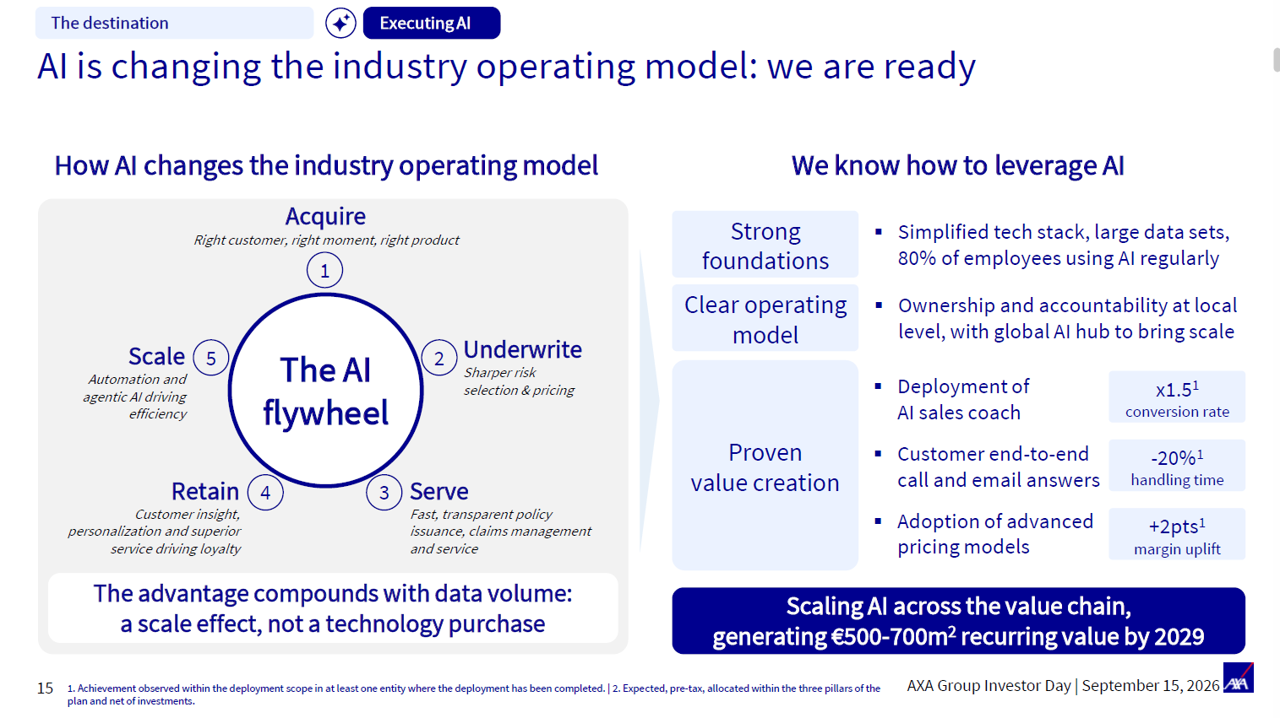
At its Investor Day on 15 September, AXA committed to €500–700m of value a year from AI, reached by 2029 and recurring from then on. The figure is pre-tax and "net of investments".¹ AXA hasn't said how quickly it builds up in 2027 and 2028.
Guillaume Borie, who runs finance, strategy, underwriting, risk and technology, said the figure also allows for "the likely increase in BAU [Business As Usual] cost": the higher running costs the technology brings.² When AXA reported its half-year results in August, its only published AI number was a 40-basis-point fall in its administrative expense ratio, credited to AI of every kind.
September’s plan is a different order of disclosure.
The slide's title (above) says AI is changing the industry operating model. Agentic AI, meaning AI systems that carry out work themselves rather than drafting something for a person to act on, appears once in the loop, at stage 5: "automation and agentic AI driving efficiency". The caption puts the advantage in data volume: "a scale effect, not a technology purchase". Data grows with size.
Thomas Buberl, AXA's chief executive, completed the picture at a Bank of America conference the following week. Asked what AXA's business model would look like in three to five years, he said: "The honest answer is probably I don't know." He added that it "will, at the end of the day, not look so different".³
How big is €500–700m?
It's a serious sum. But measured against AXA’s overall business, it's modest.
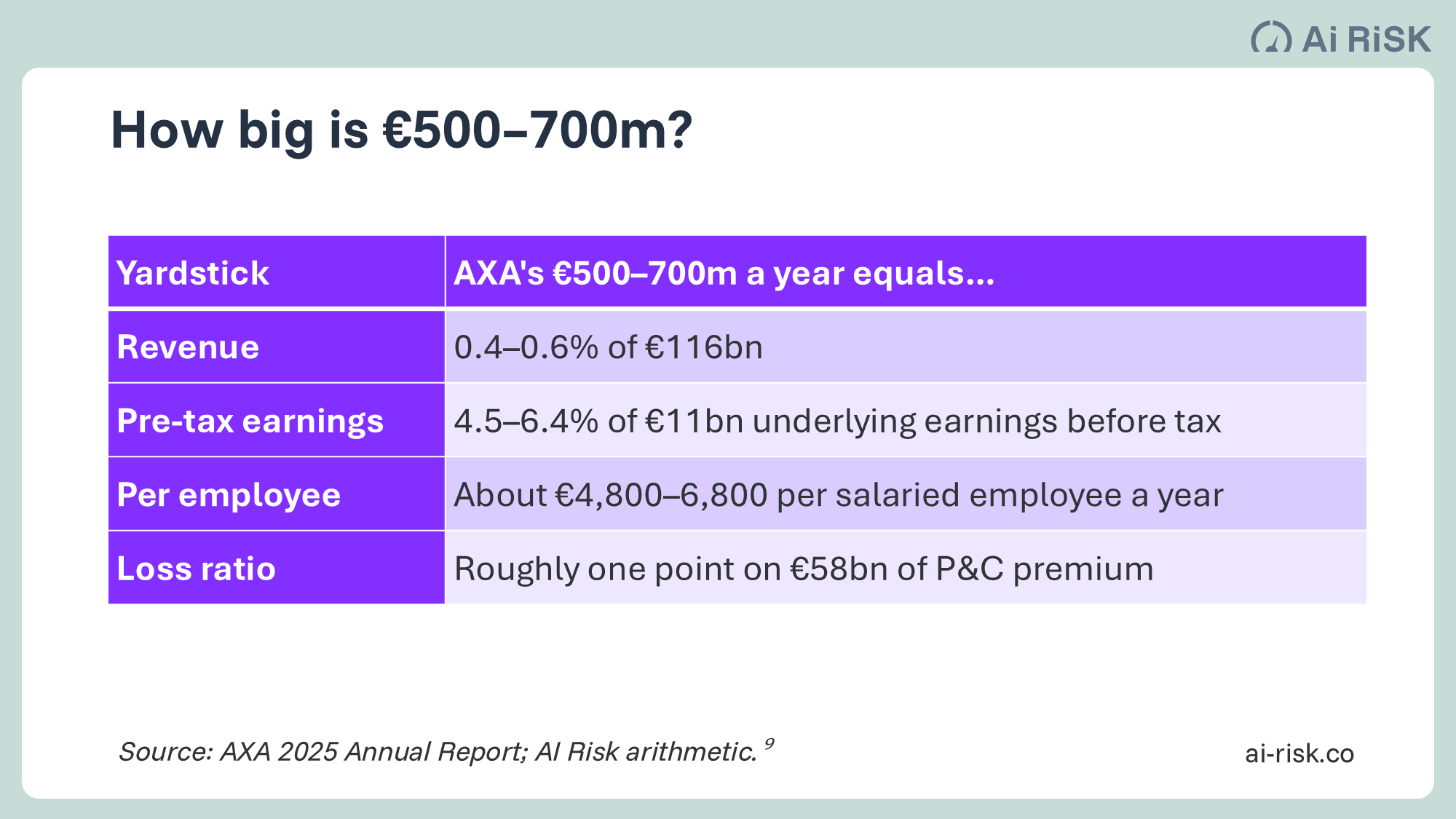
A board that scales this down to its own size will fall into three traps. AXA's number is net, where most AI business cases quote gross savings. It's what AXA expects to gain each year once the plan is complete, not the total over the three years.
And AXA spreads the fixed cost of its AI hub across €116bn of revenue, so a firm a tenth of its size pays far more than a tenth of the cost. The nearest public comparison is Generali, which reported €100m of AI run-rate value in 2025 and targets more than €350m by 2027.⁴
AXA does not say how long it will keep its gain. Almost all of it comes from making work cheaper and predicting better. Gains like these can leak away by two routes. The first is the one insurance knows from its own history. Since 2005, labour productivity has risen about 14% in P&C and 24% in life, yet cost ratios rose about 10% globally and 22% in North America: the gains went into IT cost, compliance overhead and complexity.¹⁰ AXA's figure is net of the higher running costs it expects, which guards against that route.
The second route is harder to guard against. AXA's largest rivals are buying and building the same things. As they catch up, competition passes the gains through to customers, in premiums and service. What was AXA's margin becomes the market's baseline.
AXA's size could keep it ahead of smaller rivals on cost and prediction for years. But it won't make that head start grow, because each new round of gains is open to rivals too. The value that could grow after 2029 isn't in the number, because the plan doesn't build it.
That's where the strategic risk lies. A record of judgement holds only decisions made after it starts. Each year AXA stays ahead on cost and prediction without one is a year in which a rival, of any size, can build something AXA's budget can't buy back retrospectively.
What AXA has done well
A number, defined. Net, pre-tax, recurring. Buberl's reason for publishing it was blunt: "what does not get measured does not get done".³ Most insurers publish AI ambitions with no number at all.
Built from the bottom, corrected from the top. The plan took 18 months and is, in Buberl's words, "literally an aggregation" of what AXA's country businesses submitted. Their first drafts were "very much focused on automation and cost savings", so the group sent them back. About 40% of the initiatives now target cost and automation; the other 60% target margin and growth. That split counts initiatives, not euros. Sending plans back is rarer than collecting them. It's what moved the mix towards growth.
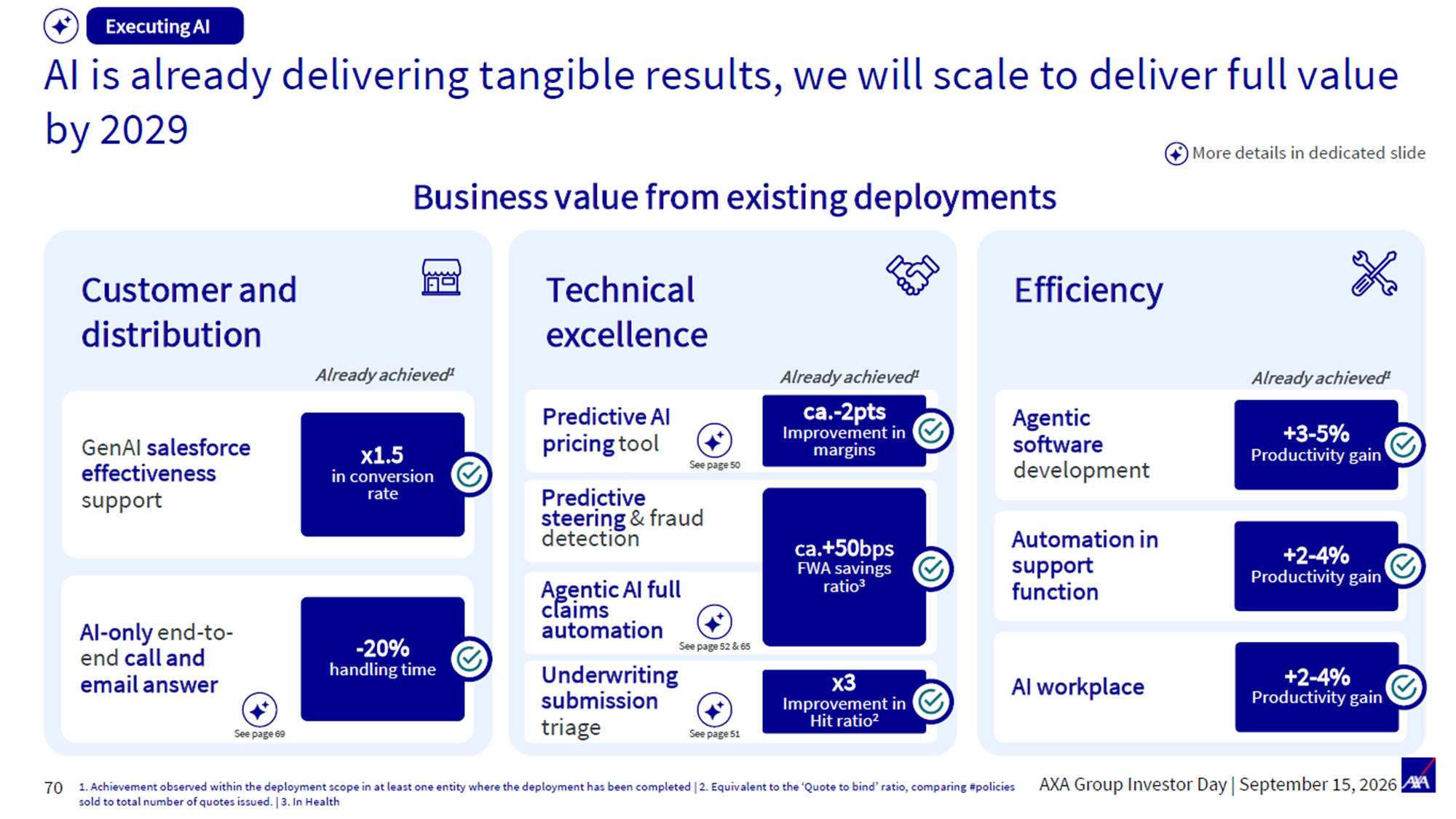
Proof points. Slide 70 (above) lists results already achieved: conversion up 1.5 times with an AI sales coach, call and email handling time down 20%, about two points of margin from pricing models, around 50 basis points of fraud, waste and abuse savings in health, a hit ratio three times higher where underwriting triage was deployed, and productivity gains of 2–5%. Each was "observed within the deployment scope in at least one entity", so these are best cases, not averages. The evidence is thin. It's still more than almost anyone else publishes.
Sound architecture. A global hub buys and builds "LLM-agnostic" capability, keeps "a central repository of reusable assets", and is built to adapt "to further technology shifts".¹ Local teams own delivery. No single supplier can lock AXA in.
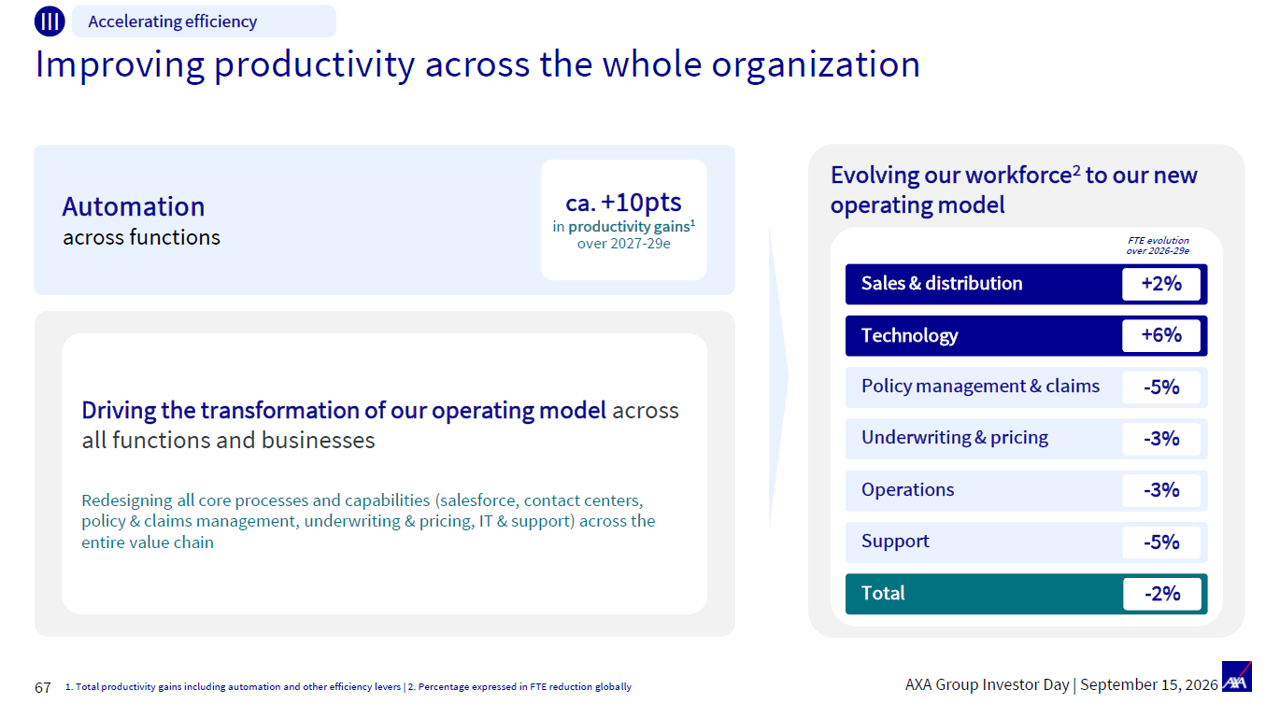
Capacity partly reinvested. The workforce plan on slide 67 (above) shows sales and distribution staff rising 2% and technology 6% over 2026–29, while policy management and claims fall 5% and underwriting and pricing fall 3%. Total headcount falls 2%. Some of the freed time goes back into growth, which a pure cost programme wouldn't do.
Where AXA's growth and margin come from
In August I suggested a first test for any AI business case: read the units.⁵ Any line stated in money per year is one a competitor can reach with the same budget. All of AXA's €500–700m is stated that way, including the 60% labelled growth and margin. To see what lasts, sort it by how each euro is produced.
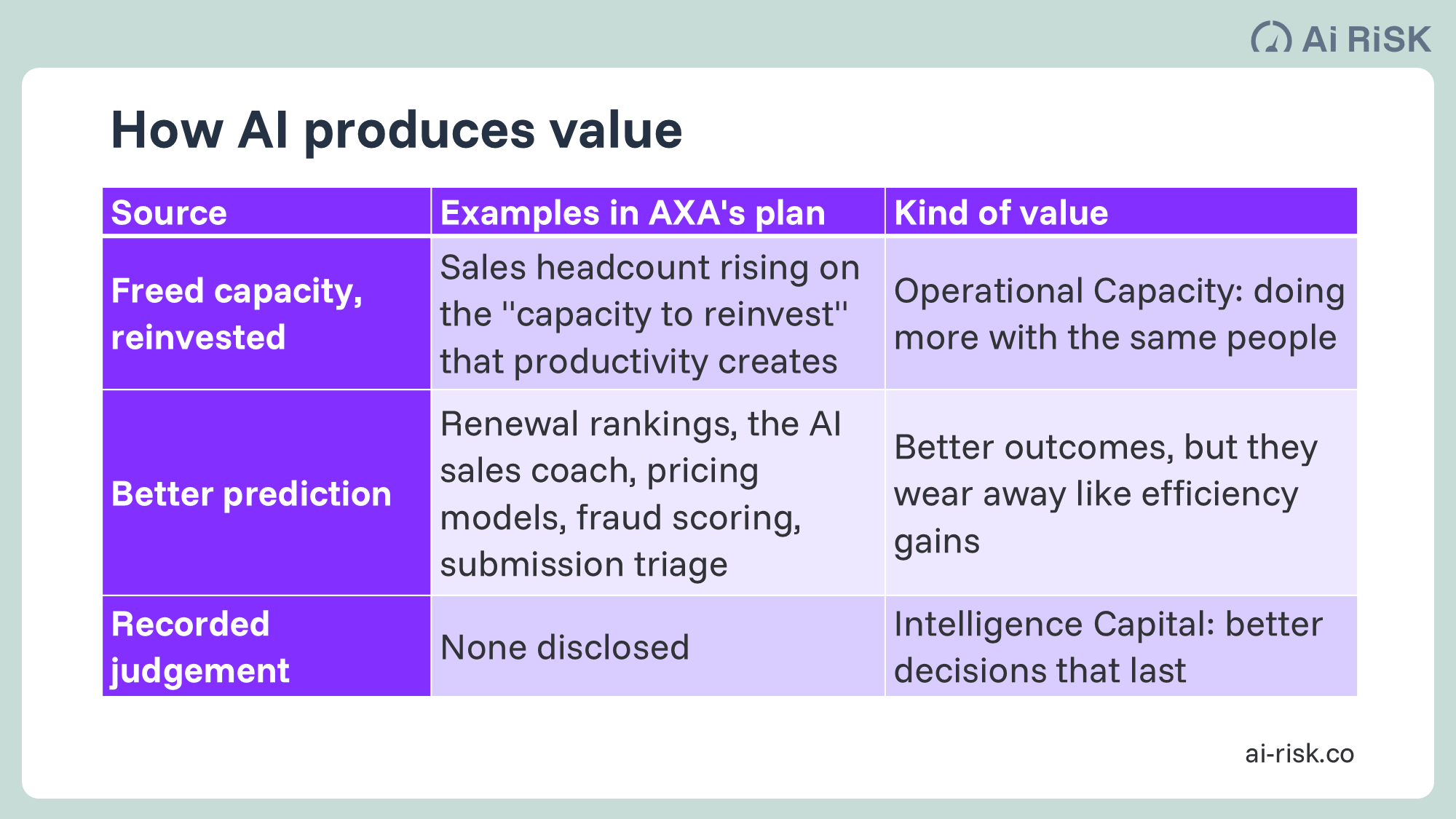
The middle row (‘better prediction’) is the one to watch. A pricing model that adds two points of margin has made AXA's decisions better, judged by results. But the gain comes from predicting well from data. Insurers of similar size hold data of the same kind, or can buy close substitutes. In lines where results arrive fast, such as retail motor pricing, their models catch up quickly.
Agentic AI does appear elsewhere in the deck, in health and medical-aid claims and in software development. Each time, the gain reported is handling time or productivity. The one agentic line under technical excellence on slide 70 shares its health fraud savings with a fraud-detection system, which is prediction again.

Put simply, AXA uses AI mostly to make work cheaper. It uses prediction models to grow and to widen margins. Neither builds anything from the judgements its own people make.
The strongest objection: AXA's models are its own
An objection at this point might be that AXA's models are trained on AXA's data, so they belong to AXA alone. That's true as far as it goes. A model trained on your own data is a real head start: in the Intelligence Capital framework, it's Information Capital, what the firm knows. The question is how long the head start lasts.
The most advanced data flywheel in financial services that I know of has published an answer. In April, Revolut's research team released PRAGMA, a foundation model: one large model trained once and then adapted to many tasks.⁶ It learned from 24 billion events across 26 million customers.
Against Revolut's own specialised models, it improved its main credit-scoring measure by about 130% and the share of fraud it caught by about 65%. (Note: these are Revolut's own figures, in a paper not yet peer-reviewed, reported relative to its internal models with the absolute numbers withheld.)

Two details matter here. Revolut trained the model on just 25 months of data, because older events may reflect patterns "no longer relevant" to how customers behave now. And every task it wins is a prediction whose answer arrives within about a year: will this customer default, is this payment fraud, will this customer buy.
That's where a data flywheel leads at its best: better predictions, rebuilt each time the world moves on. AXA is right to build one. But the advantage has a horizon, because rivals of similar size hold similar data. Where results arrive fast, their models learn just as quickly.
Five things AXA’s plan is missing
1. No record of why. Buberl located AXA's advantage in its models: AI "compounds that advantage with more data" because "our models will become better".² In August I argued that models have to be rebuilt as the world changes, while a record of decided cases doesn't go out of date.⁵ AXA’s deck says AI will free claims handlers in Swiss motor and in health "to focus on judgement calls". Nothing in the published plan keeps those calls with their reasons, or brings them back to whoever handles the next similar claim.
On the public evidence, then, AXA is building Information Capital: its data and models. It hasn't started on Intelligence Capital, the kept record of how its own people reasoned through its own cases, read back when the next similar case arrives.
That record builds durable competitive advantage.
No rival can obtain it, and not because it's guarded: it's made of decisions AXA has already taken, on its own business, in time that has already passed. Nobody, at AXA or anywhere else, has yet published proof that such a record improves decisions at scale. The first firm to show it will own the proof as well as the asset.
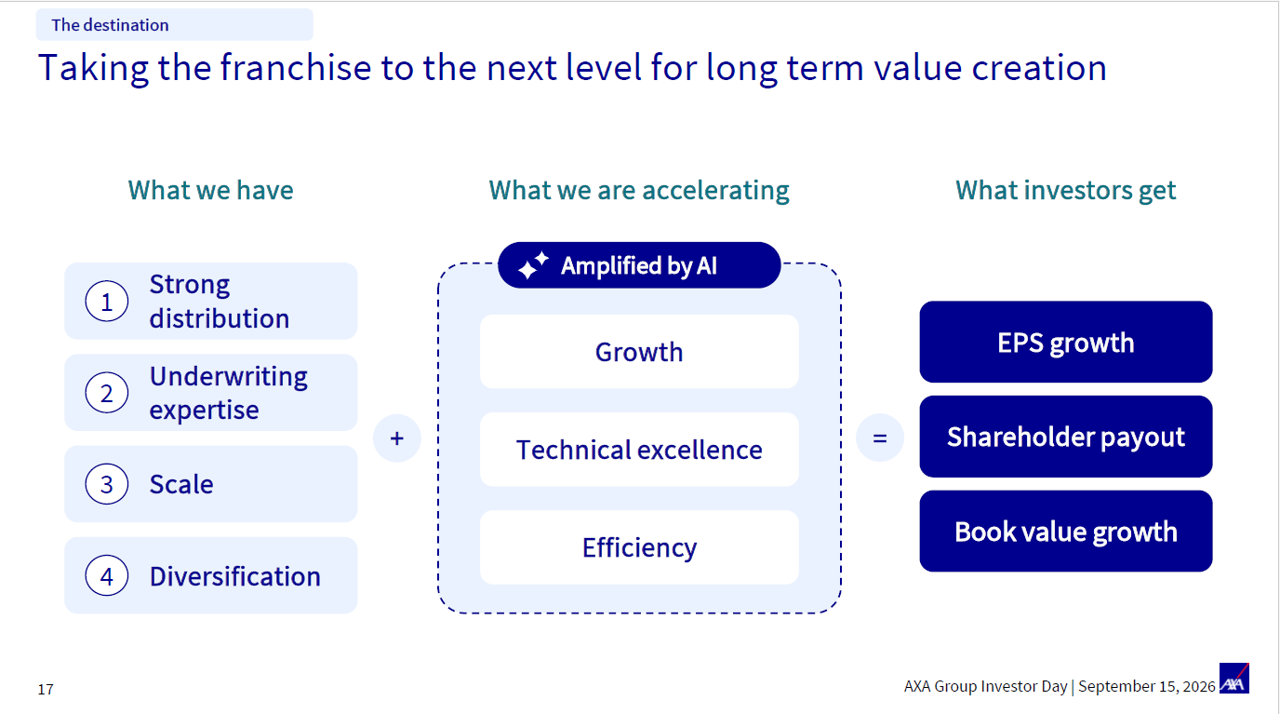
AXA's summary slide 17 (above) makes the gap visible. It lists "what we have": strong distribution, underwriting expertise, scale and diversification. The same plan cuts underwriting and pricing headcount by 3%. Nothing published says how what those people know stays behind when they go or are not available.
Expertise held only in people's heads is Human Capital: real, but it walks out of the door, and has to sleep and take holidays. The slide is also an equation: what AXA has, plus AI, equals what investors get. Nothing flows back.
One edit would change its meaning: "underwriting expertise, recorded", with an arrow from each year's decisions back into what AXA has.
2. AI that rations attention. Where the plan touches AXA's scarcest people, it uses AI to decide who gets their time. At AXA XL, triage ranks incoming quote requests "to focus underwriter time on most relevant opportunities". In retention, Buberl described agents working from rankings of which customer is "most likely to renew". Both are sensible uses of scarce time.
AXA uses AI to choose which cases get attention. Agentic AI can give every case attention. AI agents can read every submission, watch every dormant claim and contact every renewal, with experts ruling only on what's unusual.
In AXA's flywheel, though, Agentic AI sits at the efficiency stage. In policy management and claims, where most of the agentic work in the deck sits, headcount falls 5%. The service plan does aim to assist "every customer interaction" by 2029. The rationing sits with underwriters and human agents.
Agentic AI expands what I called in August Operational Capacity: the amount of work a firm can take on with the people it already has. I described two things that extra capacity does. It absorbs growth without hiring, and it reaches markets that used to cost more to assess than they could pay.⁵
AXA's plan points to a third: covering work a firm already owns but rations for want of expert time. The same limit applies. Coverage opens up only where expert time was what held the work back.
3. No measure of "better". The plan's metrics count speed, volume, cost, adoption and financial results. None measures what I’ve called the third unit: how far apart a firm's own professionals are when they decide the same case. No insurer I know of yet reports a measure of decision quality alongside cost and growth.
The hit ratio shows why that matters. AXA defines it as policies sold divided by quotes issued, so a ratio three times higher means far more business won per quote. In large commercial and specialty insurance, whether that business was worth winning shows up over years of claims. AIG reported about 40% more business bound in its Lexington middle-market property unit after deploying AI underwriting tools.⁷
Two of the world's largest commercial insurers are counting business won, on decisions whose quality won't be known for years. Even where AXA's AI agents reach complex claims, the measure is cost: in July, AXA UK described an eight-agent system handling higher-value motor injury claims with a projected 85% saving on the process.⁸
4. The slow decisions get the least detail. One question sorts any decision: how long after you make it do you find out whether you got it right? For retail motor pricing, months. For setting a reserve, settling a bodily injury claim or choosing which large commercial lines to grow, years.
Those slow decisions will do much to set AXA's P&C results over the plan. Buberl called large commercial, about a third of P&C, a "softening market" where the job is to know "where do you have to accelerate and where do you have to put your foot on the brake".³ The deck makes "cycle management in a softening market" AXA XL's task for 2027–29 and labels it "amplified by AI". But the AI disclosed at AXA XL counts submissions, quotes and cross-sell. The cycle decisions carry the label and no detail.
5. An operating-model plan for a business-model change. Buberl called the AI agenda "low risk": AXA is "just replicating what has been done well in one country at scale across the other countries. No risky experiments in AI." That's a sound way to deliver €500–700m. It's also a plan for what AXA already knows how to do.
Agentic AI changes the fundamental business model in three ways. It changes which markets a firm can serve, because it lowers the cost of assessing each case, and with it the floor: the size below which business costs more to assess than it can pay. AXA already reaches customers other insurers turn away – 24 million in inclusive insurance, by Buberl's count – by redesigning products. Cheaper assessment lowers the floor from the other side.
It also changes what a firm can sell: AXA is scaling prevention advice now. Buberl expects prevention to be a much larger part of the business within ten years.
And it changes what a firm owns when the programme ends. The workforce side above is a subject for a later Dispatches article, but one point belongs here: when judgement isn't recorded, it leaves with the headcount.
One point of loss ratio: the lever the plan doesn't pull
One point of loss ratio on AXA's P&C book is worth roughly €500–600m a year, somewhat less on net earned premium. That's about the size of the entire AI plan. That's not a prediction that AXA, or anyone, will gain that one point. It shows how much is at stake for a firm that can move it.
Two things can. Coverage: watching every dormant claim catches the ones that drift; reading every submission catches risks a ranked queue would miss. But a rival can copy coverage. Better judgement can move it too. That gain stays with the firm, because it's built from its own decided cases. Nobody has yet shown at scale that a record of judgement moves the loss ratio. It's the lever the record is built for. AXA’s plan doesn't pull it.
AXA does report one loss-ratio result: about a point better in Swiss motor claims, comparing deployed with non-deployed scope. It comes from automated damage assessment from photos and video, plus settlement and fraud tools, which any insurer can buy from the same suppliers.
What sorts a benefit is the mechanism that produced it, not the line it lands on. This point belongs with efficiency and prediction, however welcome it is.
Augmenting AXA’s plan with ‘Intelligence Capital’
This slide is AXA's current summary of Growing Forward.
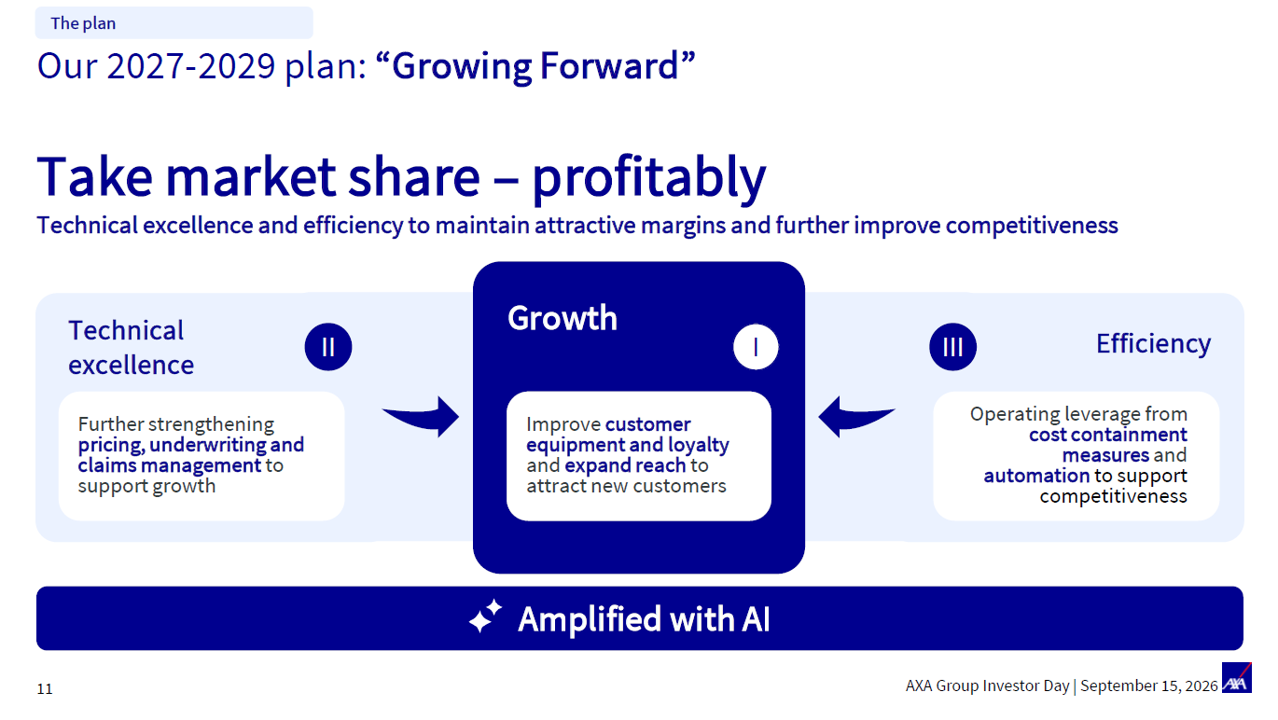
I’ve redrawn it, below, with what the plan leaves out.
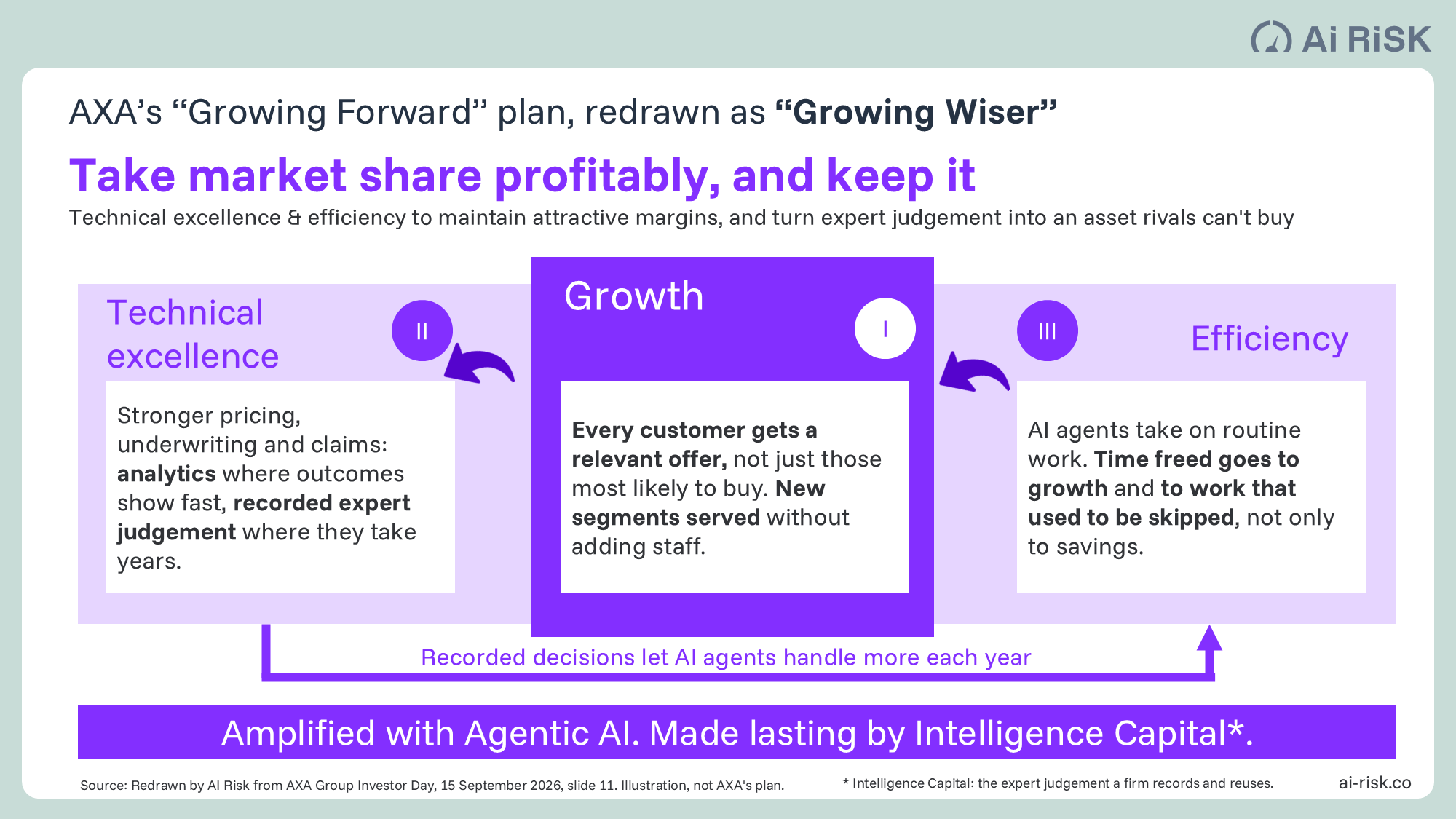
In this augmented version AI agents make a relevant offer to every customer, not only those who analytics ranks as most likely to buy (eg. a home insurance quote for every motor customer who moves house). And the firm serves segments that were too small to price by hand (eg. small businesses wanting a single policy), without adding staff.
Technical excellence uses advanced analytics where outcomes show fast (retail motor pricing, routine claims), and recorded expert judgement where they take years (complex commercial underwriting, large injury claims).
Efficiency sends freed time to growth (more customers served without hiring) and to work that used to be skipped (checking dormant commercial claims before they grow) or rationed (reading every broker submission, not only the highest-ranked).
The arrow along the bottom is what AXA's plan lacks. Each recorded decision lets AI agents handle a little more the next year. This brings three benefits:
Experts spend less time on cases and situations the firm has already settled and more on the ones it hasn't.
Decisions become more consistent, because the same case gets the same answer whoever handles it. And that answer moves towards the standard of the firm's best people rather than its average.
The firm keeps what its experts know when they leave, change roles or retire (or have signed off for the day or are on holiday), in a form no rival can buy.
Two practical conditions have to hold, which I set out in my August article. The record has to reach whoever decides the next similar case, without anyone having to remember to look for it.
And similar decisions have to come up often enough for disagreements between colleagues to surface, so that senior people can settle them. Fail the first and the firm has built an archive. Fail the second and it has built nothing.
What AXA’s plan means for everyone else
Buberl told investors that AXA will most likely take share from smaller insurers that lack the means, or the ability, to get their employees and human agents using AI.² Executives at those insurers will soon be asked for their version of the €500–700m.
The tempting answer is a smaller copy of AXA's plan. That's worth doing: the savings are real, and a firm that doesn't make them will fall behind. But a copy produces the same kind of value as AXA's, at a higher cost per euro, while every rival makes the same gains. As they do, much of the gain passes to customers. A copy keeps you in the race, but it gives you nothing a rival can't also buy.
If you run – or are part of running - one of the other giants, such as Allianz, Zurich, Generali or Chubb, you can match AXA's wheel. Your choice is, then, whether to run the same race or build a second (Intelligence Capital) wheel, which no incumbent has yet shown in public.
If you run a mid-sized European retail carrier, don't fight the data wheel. Buy the best efficiency programme you can afford, and lead on it. Rent the platforms and the models, but make sure the record of your decisions is yours. Use freed capacity to cover work you now ration, rather than taking it all as headcount. Start the second wheel where decisions are slow to grade and frequent enough to learn from: bodily injury, complex claims, SME underwriting.
If you compete with AXA XL in specialty or at Lloyd's, the hit ratio is the warning. Business won per quote is not business worth winning. Your cycle decisions, which lines to grow and where to hold back, are where a record of judgement pays off most.
If you're in health, life or assistance, the race to automate claims will go to the largest players. Medical underwriting and advice are the slow decisions. That's where a smaller firm can build something the giants haven't.
If you run a digital MGA, your cost advantage is starting to shrink: AXA is targeting an expense ratio below 10%, excluding commissions, by 2029. A low cost base alone will no longer set you apart. What you decide, and what you keep from deciding it, will.
If you're a broker, your advice on placement and on clients' risks takes years to prove right. A record of why your best people advised as they did is something no carrier or rival broker can copy.
If you're outside insurance, read AXA as a free preview, as JPMorgan has been for banking.
Three tests for your own plan
AXA has built one flywheel, and built it well. Copy it, and you have no durable advantage. Before your board signs off your own version, put three questions to it:
Which of our AI advantages depend on size: the volume of our data, a central AI team whose cost is shared across a large business, the ability to hire scarce talent?
Which of our decisions take years to show whether we got them right, and what in our plan makes those decisions better?
What would still belong to us if our main AI suppliers and platforms left tomorrow?
Then ask the one that sums them up. If a rival spent exactly what we spend on AI, what would we have that they couldn't buy?
Simon Torrance is CEO of AI Risk, an Agentic AI strategy and implementation consultancy. For the foundations of the Intelligence Capital thesis, see The AI Your Competitors Can't Buy.
Footnotes
¹ AXA Group Investor Day, 15 September 2026, presentation: slide 11 (plan summary, redrawn above), slide 14 ("create capacity to reinvest"), slide 15 (flywheel, €500–700m, "expected, pre-tax… net of investments"), slide 16 (2029 targets), slide 17 (destination), slides 50–51 (AXA XL triage, Swiss motor), slide 64 (health claims), slide 67 (FTE evolution 2026–29e), slide 70 (results already achieved), slide 71 (global hub), slides 127–131 (AXA XL).
² AXA Group Investor Day, 15 September 2026, transcript: Guillaume Borie on the €500–700m; Thomas Buberl on AI compounding with data and on taking share from smaller companies (Q&A).
³ Bank of America 31st Annual Financials CEO Conference, September 2026, transcript of Thomas Buberl interview.
⁴ Generali figures as reported by Insurance Business, June 2026.
⁵ Three Kinds of Value from Agentic AI. Your Business Case Only Funds One. Dispatches from the Agentic Frontier, 27 August 2026.
⁶ Ostroukhov et al., "PRAGMA: Revolut Foundation Model", arXiv:2604.08649, 9 April 2026. Preprint, not peer-reviewed. All results are relative to Revolut's internal task-specific models; absolute metrics are withheld as commercially sensitive. Credit scoring +130.2% PR-AUC; external fraud +64.7% recall; pre-training window 25 months, 2023–25.
⁷ AIG first-quarter 2026 earnings call: Lexington middle-market property, roughly 40% more business bound alongside 30% more submissions quoted.
⁸ InsTech and AI Risk conference on Agentic AI, 7 July 2026, as reported in Your AI Spend Is Buying Parity, Not Advantage, 27 July 2026.
⁹ AXA 2025 Annual Report: revenue €115.5bn, underlying earnings before tax €11bn, P&C gross written premium €58bn, 103,423 salaried employees. Loss-ratio point calculated on gross written premium; net earned premium is lower.
¹⁰ Consultancy research on insurance productivity and cost ratios since 2005, McKinsey.