Three Kinds of Value from Agentic AI. Your Business Case Only Funds One.
Dispatches from the Agentic Frontier is a regular intelligence briefing for leaders in knowledge-intensive sectors. Each dispatch translates evidence from the frontier of Agentic AI – practitioner experience, investor signals, strategy research, market events – into what it means for enterprise leaders building for competitive advantage. All are filtered through the Intelligence Capital framework developed in The AI Your Competitors Can't Buy.
Summary
Efficiency gains depreciate, operational capacity can be copied, and only Intelligence Capital appreciates. AI and Agentic AI business cases today are pricing the first and missing the rest, so firms are funding the value they can't hold on to. The article explains why and what to do about it.
You're only funding the value you can count
Anyone writing an Agentic AI business case has to say where the return will come from. Almost every case gives the same answer: taking cost out of today's work.
Each case is approved on its own merits. Approve twenty of them and the whole AI budget has gone to one kind of return – a far bigger decision than any of the twenty, and one nobody in the approval chain was ever asked to make.
The cost line wins because it arrives already measured. Take the number of people working on a process, the hours the work takes, apply a percentage, and a CFO has a figure for the plan. The other two kinds of value (see below) start from nothing: one needs a question firms rarely ask, the other a number almost no firm holds.
So the line that arrives measured is the line that gets funded. The arithmetic is often sound, and it's worth having.
It just isn't the line that decides whether you still own anything valuable in five years' time.
Three kinds of value
An Agentic AI investment can buy three quite different things:
Doing today's work more cheaply.
Doing more of it than your headcount used to allow.
Deciding better, built from judgements only your firm has made.
Put one question to each: what happens to this value once every rival has implemented the same tools?
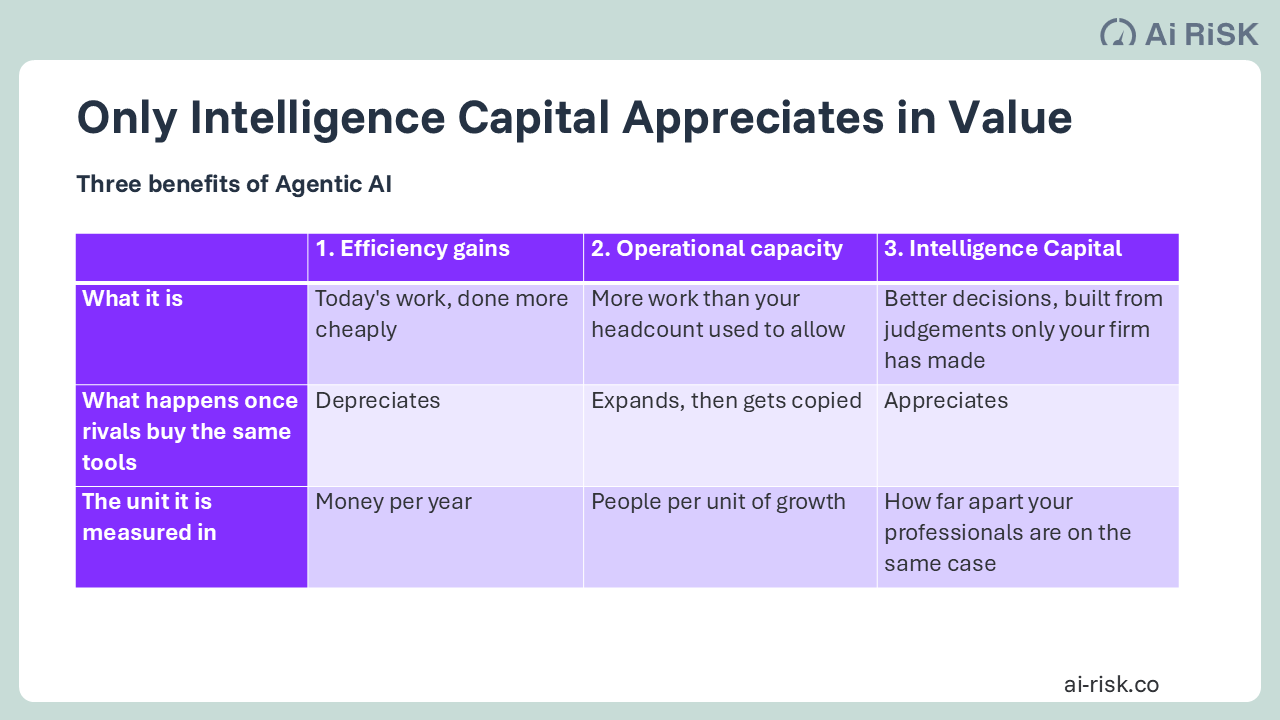
The three behave in three different ways. Efficiency gains depreciate. Capacity expands. Intelligence Capital appreciates.
The first kind: doing today's work more cheaply
The money here is real. It arrives first, it's the most tangible of the three, and an executive who delivers it, at scale, has done something difficult. Tell that executive the gains are, ultimately, the disappointing part of Agentic AI and you'll, quite rightly, get shown the door. Speed that customers notice belongs here too. A good outcome, delivered sooner, is a better experience – but, from a firm's point of view, the category of value doesn't change. When the speed comes from taking human time out of the work, faster and cheaper are the same thing.
At our July conference on Agentic AI for insurers, Pieter Viljoen of Allianz Partners presented what is, to my mind, one of the most advanced live Agentic AI programmes in the world today. His firm now settles around 60% of eligible claims end to end without a person involved, and has cut average settlement time from 29 days to 3.5. The hard, measured targets in the programme sit in this efficiency category.
Two things often get modelled badly in efficiency cases:
Whether the saving reaches the firm at all: Microsoft recently ran a randomised trial across 66 firms and found around two hours a week saved per person on email alone – small per head, but in a two-thousand-person firm that's a hundred people's worth of time. The hours were real. Output didn't move, because nothing about the work was redesigned to take advantage of the freed time. A business case that books saved minutes as money is assuming the redesign it never budgets for.
What an agent costs to run: one recent analysis counts seven line items – tokens, licences, platform, governance, change management, failure and recovery, a possible future AI tax – while most business cases stop at the first three.¹
And there's a hard truth beneath both. Everything in this category is on sale to your competitors on the same terms. Once they've implemented it too, competition passes the gains through, and what was your margin becomes the market's baseline.
As a result this first kind of value depreciates. Move first and execute better than your slow-moving competitors and your lead could run for years rather than months. But bought efficiency never accumulates: you have to re-earn the lead each cycle, and winning the first round doesn't automatically hand you the next one.
The second kind: growth that doesn't need hiring
Operational capacity here refers to the amount of work your firm can take on with the people it already has. Agentic AI expands it because teams of agents can increasingly carry out work that used to require human hours. As a result, business volume becomes de-coupled from headcount.
This new type of capacity does two things, and business cases usually count only the first.
It de-risks the growth plan you already have: volume you expected to absorb by hiring gets absorbed without it. This matters most where people take years to train – underwriters, credit officers, senior lawyers. ING's Agentic Mortgages service went live in the Netherlands this year; asked on the July results call what the bank was getting, its chief executive put it plainly: more revenue, because customers are helped faster, and cost avoided, because the extra volume needs fewer people. Measure it as the change in hiring needs; the baseline number is already in your growth plan.
It alters which markets you can enter. Every judgement business has to assess work before taking it on: is this worth doing, at what price, on what terms? The assessment takes expert time, which often barely falls with the job size. In commercial insurance, for example, a policy earning £2,000 of premium still needs the customer’s application read, the risk understood and a price set – not a hundredth of the effort of one earning £200,000. The fee falls a hundredfold; the work of assessing doesn't. So below a certain size, deciding whether to take the work costs more than the work can pay, and the answer becomes no. That's the floor: the smallest job worth taking on. It's why a law firm won't take on the small dispute, and why whole segments go unserved.
This is what Agentic AI changes. Agents read what comes in, weigh the job and draft the terms in minutes, and the expert rules only on what's unusual. The floor was made of expert hours; take most of them out and it drops. Two routes open up as it does:
Markets nobody serves: for example a two-year-old MGA - a specialist insurance underwriting business – my team helped establish is run largely by teams of collaborating AI agents. It makes roughly double the industry-average profit in a segment seen by traditional providers as uneconomical.
Markets already served well, by firms whose cost base is human time, undercut from beneath by an entrant built around AI.
One test stops this turining into a general rule that “AI opens every market”: human time needs to be the constraint. If the barrier is capital, a licence, regulation or distribution, nothing has moved.
This second kind of value expands: it makes the firm bigger – more volume absorbed, more markets in reach – rather than making today's work cheaper. A rival can build the same capacity. It may take longer than they expect, because an agentic workforce has to be managed carefully as a workforce, and the skills for doing so are extremely rare today. But they’ll get there in the end.
One more thing about the floor. When it drops, the firm doesn't just take on more work – it makes far more judgement calls, because every newly affordable job still has to be assessed, priced and decided. Thousands of small decisions where there used to be hundreds of large ones. Volume like that is exactly what the third kind of value needs.
The third kind: making better decisions
The third kind of value is better decisions.
By that I mean getting right the decisions a judgement business lives on: what to take on and on what terms; what an investment, a claim, a dispute or a debt is worth; when to press on and when to walk away – and getting them right consistently, whoever is deciding. Faster and cheaper leave those answers untouched: a firm can automate the whole process and decide no better than it did before.
Almost nobody measures it.
Let's review some figures that look like they demonstrate this third kind of value but don't. The Allianz Partners numbers – 60% of claims end to end, 29 days down to 3.5 – are two I'd sign off in any business case in this market. But neither tells you a claim was settled at the right amount. Settled faster is not settled better, and the distinction is easy to lose, because these numbers look like decision quality to everyone in the room.
Allianz does publish an accuracy figure: 99.7% of decisions traced to policy terms. But mind the denominator: it counts the claims routed to automation precisely because the policy can settle them. Within that tier, the figure is real and impressive. The decisions that set an insurer's ultimate results – the risk priced, the reserve set, the claim the wording doesn't settle – never enter it.
Other people who design AI metrics have the same gap. Economists Erik Brynjolfsson of Stanford and Andy McAfee of MIT were asked recently what a firm should track while it waits for the profit line to move.² They named time saved per person per week, the money value of AI usage, and the quality of that usage. Every item on that list can be stated in money per year. None of it touches our third kind of value.
The market counts the same way. Half the respondents to the longest-running global survey of enterprise AI say AI helps them make better decisions – a feeling, recorded as the share of people who report it.³ When the same survey turns to enterprise value, it asks for magnitudes: profit contribution, cost taken out, revenue added. Nobody is asked for a number on decisions.
So here's the test to run before writing the next business case, and it needs no AI. Put a live problem in front of everyone who does that job, separately, and measure how far apart the answers come out. That spread is your starting position. Almost no firm has the number; published audits of insurers found gaps far wider than executives had predicted. I wrote about those a fortnight ago in Your Company Is Throwing Away Its Thinking.
Now the hard part…
In the business case you're writing next, this will be the smallest of the three numbers, because a record starts empty and efficiency benefits arrive first. But only one of the three still belongs to you in five years.
What grows is the share of difficult decisions your firm can settle to the standard of its best people, with none of them in the room. That's what better means here, and the number you just collected is how you'd see it: the spread narrows towards your best practice rather than your average, because disagreements stop being averaged away and start being ruled on.
Every difficult decision, made and recorded, moves that line outward; the experts you free up go to the work further beyond it. Two conditions have to hold:
The record has to come back to whoever faces the next similar decision, without anyone remembering to look for it.
The decisions have to be frequent enough that disagreements pile up into something senior people can rule on.
Fail the first and you've built an archive. Fail the second and you've built nothing. (Decisions that can be graded fast, cheaply and reversibly – retail pricing, most call-centre work – don't need a record: you can simply test alternatives and keep whichever wins.)
The reasoning record is the thing you build. Intelligence Capital is what accumulates inside it.
Virtually all published results are all still on the efficiency side, across all sectors. In insurance, for exmaple, AIG, Munich Re and Allianz Group all reported AI results on 7 August and stayed inside efficiency language; Allstate's chief executive went furthest, claiming future accuracy gains in pricing and claims – no figures, platform under construction. Everyone is circling the second and third kinds of value. Nothing published yet shows how to build for them, which is why nothing published measures them.
There's a standing answer to all this, which is a good one: returns lag because the reorganisation around the technology is the real investment, and firms that do that work well pull away. That's true, and it's an argument about speed. Doing the reorganisation well gets you to the first kind of value sooner than your rivals. It doesn't change what you're left holding once they arrive.
So how do you fund something with a clear mechanism behind it but no proof at scale? Not at scale. Fund the validation: one commitment small enough to be wrong about, the record switched on while it runs, and the measures named in advance that would tell you inside a year whether it's taking hold.
This third kind of value appreciates.
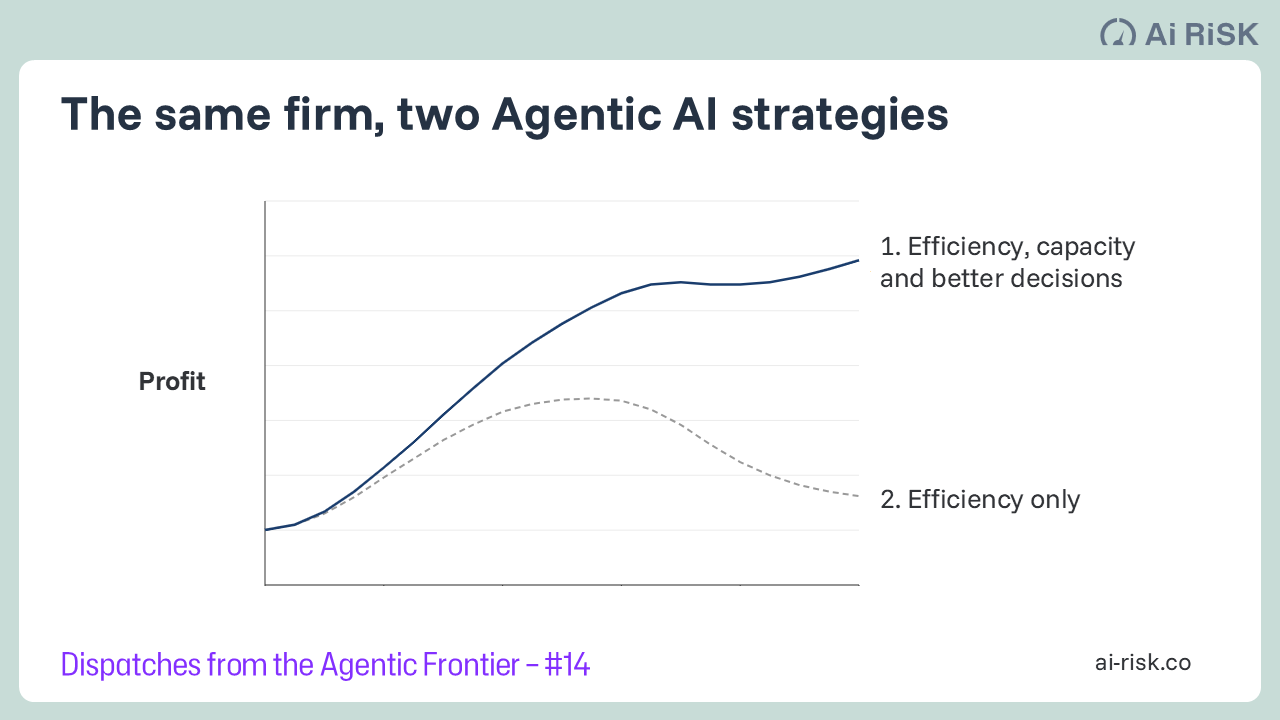
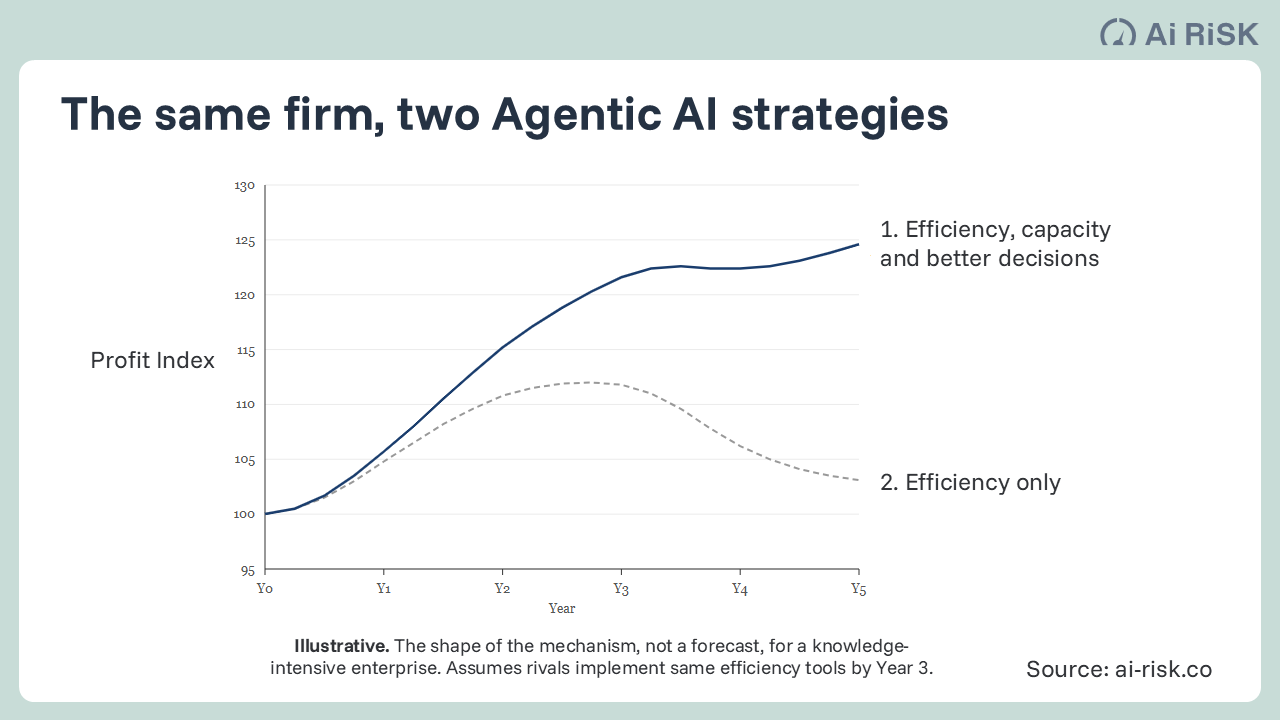
The chart shows the shape of the argument, not a forecast: one knowledge-intensive firm running its Agentic AI programme two ways, differing only in what the programme is asked to produce. In this scenario rivals have implemented the same efficiency tools by Year 3; the first-mover lead is real, but it ends. Both lines take that hit. Only one is still climbing afterwards.
Why a record of decisions doesn't go out of date
An executive hearing the word "appreciates" might feel she has a good objection ready. AI systems typically get worse over time unless you keep rebuilding them. Why wouldn't this one?
Because a model and a record are different kinds of thing. An AI model works out patterns from past data and predicts what happens next; when the world changes – new competitors, new consumer behaviour, new regulations – the predictions decay. That's why production agents get adjusted every few days and sometimes scrapped and rebuilt.⁴ A record of a settled decision predicts nothing. It says what your firm weighed, and what it concluded, at a moment that has passed. Nothing that happens later makes that account untrue.
The change that damages an AI model becomes material inside a record. An underwriting team, for example, reasons one way about a risk in March; by October the same reasoning looks wrong. Both entries sit in the record, The gap between them shows the firm how its own thinking changed. Where the result of their decision arrives years later (often the case in insurance), the record answers the only fair early question – was the reasoning sound given what was knowable – and never scores a decision by its result alone, because a well-reasoned risk in insurance can still go bad.
The thing you keep rebuilding is the AI agent. The thing you keep is the record.
Why start now
An economic downturn is when this matters most, because a budget under pressure funds the money-per-year line and little else. The reasoning record is valuable in any conditions – your people disagree just in the good times just as much. But some decisions only exist while margins are tight, and a record switched on afterwards never sees them.
Insurance is living this right now: declining the risk rivals are chasing, holding a price while others cut theirs, setting the reserve on business taken on at the top of the market. Prices are falling across much of the sector,⁵ so profit increasingly depends on which risks a firm takes and where it walks away – all of them daily decisions.
The same pressure reaches any firm that sells judgement.
This is reasoning, not a measured result: nobody has compared a record begun in a downturn with one begun in better times. What is certain is the cost of waiting. Postpone any other line in the business case and you lose time. Postpone the reasoning record and you lose the decisions themselves. Start a year late and, when conditions turn again, the firm holds only anecdotes about how its best people made judgements during this period.
What to do with the next business case that reaches your desk
I suggest three steps, in order.
First, read the units. Every line stated in money per year is a line your competitors can reach with the same budget as you.
Second, run the spread. Ask the two questions the current business case probably isn’t addressing. How much more business could we take on without hiring, against which approved hiring plan? And how far apart are our own people on the decisions that set our margins? The first number is in your growth plan. The second takes a fortnight and needs no AI.
Third, fund one validation small enough to be wrong about. Buy the best efficiency programme you can afford and lead on it. Then spend a small fraction of the same budget testing the other two kinds of value, with the records switched on and the measures named in advance.
The reason to move now relates to what your monthly reporting pack can't show you. A competitor coming after you with agents doesn't need to take your customers, only the profitable part of the work: revenue might hold, market share might hold, but profit won’t.
The business you could take on without hiring, and not the spread between your own people on the same problem does not come in units of money per years. That's why they're the ones worth having.
Simon Torrance is CEO of AI Risk, an Agentic AI strategy and implementation consultancy. For the foundations of the Intelligence Capital thesis, see The AI Your Competitors Can't Buy.
Footnotes
¹ Agent run-cost taxonomy: consultancy analysis, EY, 2026. Several of the seven vary case by case, so operating cost belongs in the case as a range, never a unit price.
² Webinar, "Why are companies spending billions on AI but struggling to prove ROI?", Workhelix, August 2026 – the measurement company Brynjolfsson and McAfee co-founded. For the underlying research, see Brynjolfsson, Rock and Syverson, "The Productivity J-Curve".
³ McKinsey Global Survey, "The state of AI in 2026: On the road to ROI", QuantumBlack, AI by McKinsey, 25 August 2026. 1,719 respondents in 97 countries, fieldwork 4 May to 8 June 2026. The 50% figure is individual self-report (Exhibit 5). Enterprise value is measured by EBIT attribution, by objective (efficiency, growth, innovation; Exhibit 10), and by function-level cost and revenue change (Exhibits 6 and 7). Figures cover all AI use, not Agentic systems specifically. Link: https://www.mckinsey.com/capabilities/quantumblack/our-insights/the-state-of-ai#/
⁴ "Where AI agents pay off: a practical guide to the economics of agentic workflows", QuantumBlack, AI by McKinsey, 2026: firms report adjusting production agents every few days, and sometimes retiring and rebuilding them.
⁵ Lloyd's of London market guidance to syndicates, May 2026: rates easing faster than expected across most specialty lines, with syndicates asked to plan realistically.