
The Myrmidons. Greek god Jupiter turned ants into men to re-populate King Aeacus’s island after it had been hit by plague. They were hard-working, thrifty and patient. His grandson Achilles later led them at Troy as his loyal fighting force.
Dispatches from the Agentic Frontier is a regular intelligence briefing for leaders in knowledge-intensive sectors. Each dispatch translates evidence from the frontier of agentic AI — practitioner experience, investor signals, strategy research, market events — into what it means for enterprise leaders building for competitive advantage. Some dispatches are field reports from practitioners who are 12–18 months ahead. Others synthesise emerging research. All are filtered through the Intelligence Capital framework developed in The AI Your Competitors Can’t Buy.
Summary
Agentic AI is a new workforce, but most companies are still treating it like software. This briefing sets out what makes it different, what it delivers, and why the CEO must own the strategy. It focuses on insurance, the sector most exposed.
Why Agentic AI is different
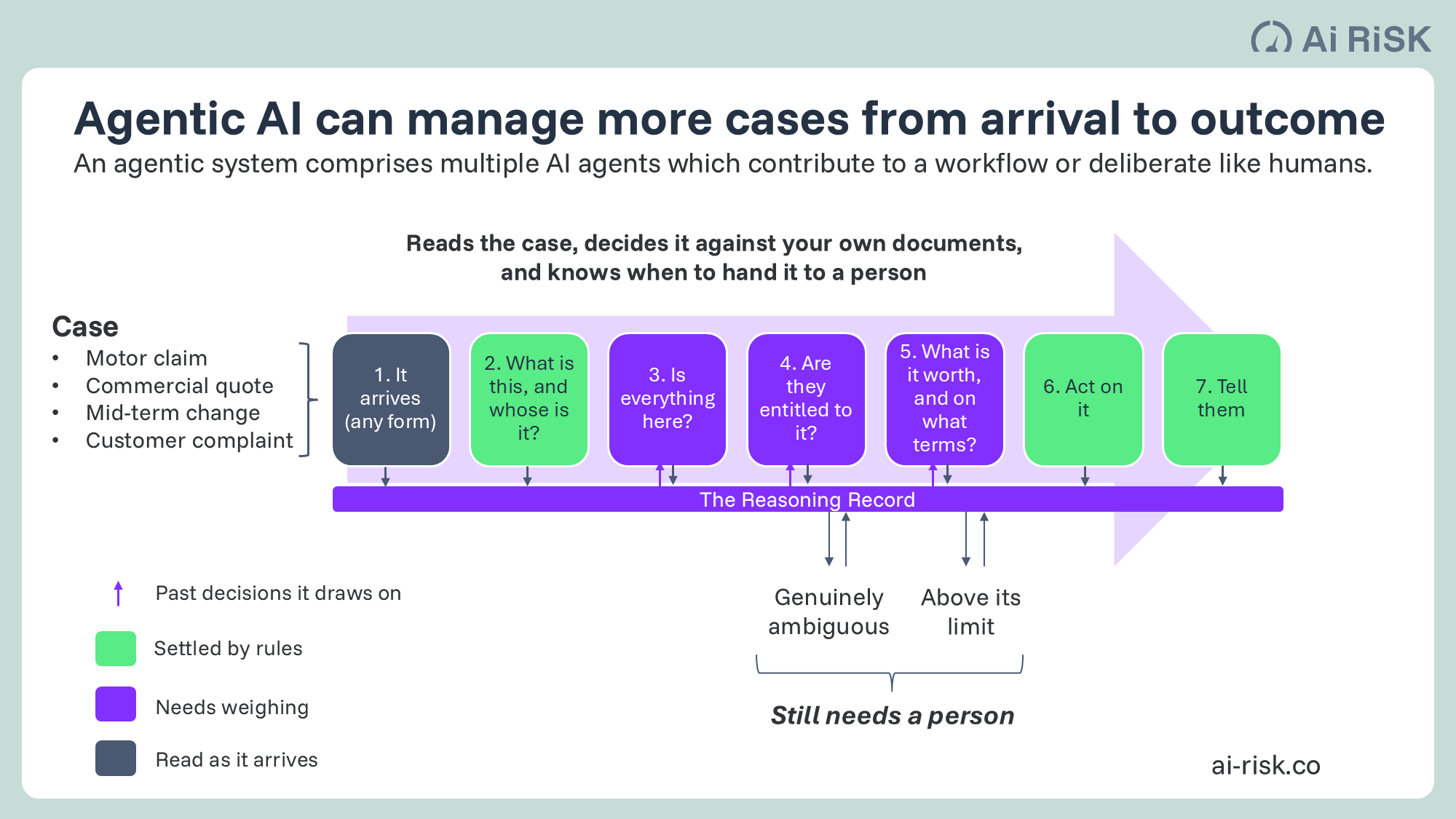
Other forms of AI predict, draft and summarise, while people do the work. Agentic AI does the work itself: it reads the file, makes the call within limits set, and hands a person the cases that need human judgement or empathy.
Take a commercial property submission (a request, through a broker, for insurance coverage). Today it may take days for an underwriter to respond to it, and some submissions are not properly read. AI agents can read each one as it arrives, check it against an insurer’s risk appetite, gather the missing information, propose a price (within limits), and pass the unusual ones to an underwriter with their proposed response set out.
That example, replicable across all functions of the business, illustrates how Agentic AI is much more than a tool, it’s a digital workforce, one that can take on more work at little extra cost. Like any workforce, it needs controls, supervision and a person accountable for every outcome. As a result most of the effort in exploiting it is organisational rather than technical.
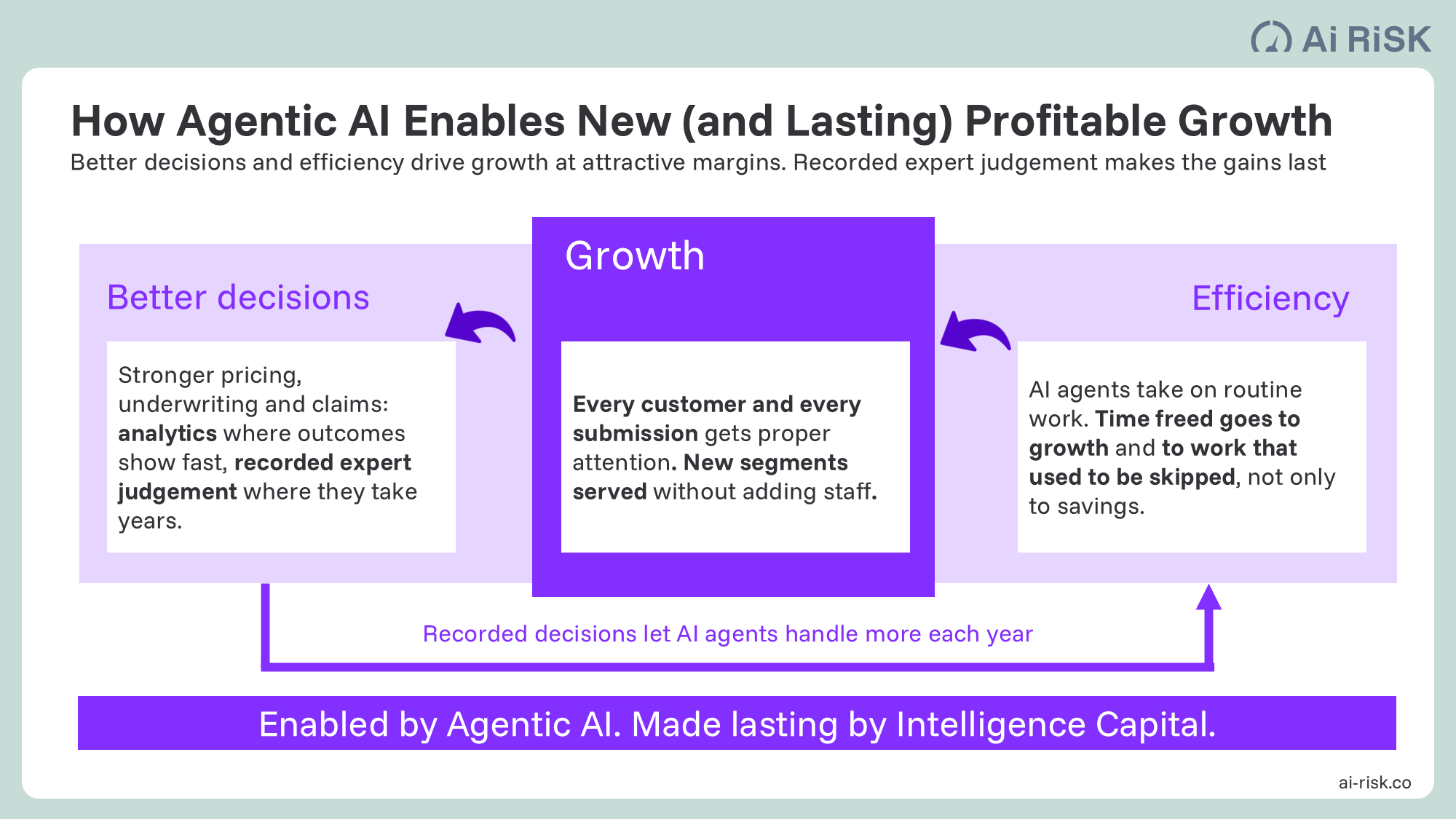
A workforce that costs little to add changes what a firm can attempt. Work avoided or rationed for want of expert time can be undertaken and done in full. Customers who cost too much to serve come back into reach, which helps close protection gaps. Insurers can not only pay claims but also help customers prevent them.
And for the first time, AI reaches the decisions that drive the loss ratio, not just the administration around them: which risks to take, at what price, and which claims to pay. That lets you, as an insurance leader, rethink how you create value for customers and how much of it you keep. Used only to automate, Agentic AI delivers efficiency: those savings are significant, but every rival can buy the same enabling tools, so your edge over them narrows within a few years.
A new asset you must own
Agentic AI also has the potential to create a new asset. When digital workers do work only people used to do, everything they decide, and every exchange with the people who supervise and overrule them, can be recorded in software with the reasons.
Over time that record becomes your firm's accumulated judgement, which gains value with use where every tool you buy depreciates. We call the recorded reasoning Intelligence Capital. Some others have started using the term for the AI models, prompts and tools a firm reuses from one project to the next. But those simply make each project cheaper to run.
Intelligence Capital, as we use the term, is the judgement that builds up in the record of how your people decide. It makes the next decision better, which is how the loss ratio improves. (More on this here).
It's a powerful asset. You must own it, otherwise - by default - it ends up inside your suppliers' software.
Three returns, one programme
A joined-up strategy for fully exploiting Agentic AI delivers three returns. They arrive at different speeds. Efficiency and operational capacity show up mainly in the expense ratio. Intelligence Capital shows up in the loss ratio, usually the larger of the two, which most AI programmes today aren’t designed to reach.
Efficiency arrives first, and it's significant. Cost per case falls. Allianz Partners, for example, now settles about 60% of claims without a person, has cut average settlement time from 29 days to 3.5, and is targeting about €300m of extra annual profit by 2027. In servicing, routine requests such as a change of car or address can be completed in minutes, with no person involved. Surplusses like these give a CEO options: increase returns to shareholders, cut prices, improve service, launch new products, reward loyal employees, or a mix. They also fund the other two returns.
Capacity and coverage arrive next. You take on more clients and cases without hiring in proportion. Work you have to ration today gets done in full: every dormant claim watched, every commercial policy monitored against appetite, and every personal lines customer offered a review of their cover at renewal.
Intelligence Capital accumulates most slowly, but it is the only one that lasts. Judgement varies far more than executives assume: in Nobel laureate Daniel Kahneman's ‘noise’ audits, underwriters pricing the same risk differed by a median of 55%, where executives expected about 10%. Today that spread is invisible, because the firm gets two prices and no reasons. With the reasons recorded, when people disagree the firm can see the basis – the exposure, the precedent or the price – and a senior person can rule on it. The ruling then becomes a standard that AI agents can apply at scale. Whose judgement sets, or adjusts, that standard is a choice to make deliberately and a new organisational skill to develop.
Intelligence Capital builds slowly, so you need to start now: the Reasoning Record, where Intelligence Capital accumulates, only holds decisions made after it's switched on. What then grows is the share of difficult decisions your firm can make to expert standard without an expert present. Each hard case recorded moves that boundary and frees your experts for the cases still beyond it.
In commercial insurance, for example, we typically design for an improvement of 1–2 combined ratio points a year once enough hard cases have been recorded and ruled on for AI agents to handle a real share of them. That's a target, not yet a result. (More on the logic here).
Two conditions keep this value growing: past reasons must reach whoever makes the next decision; similar hard cases must come up often enough to learn from. Where both hold, durable competitive advantage is built. Where both hold, durable competitive advantage is built. A rival can buy the same tools and build its own record, but that record will only hold its people’s judgement, not yours, and only from the day it starts.
Long before AI agents can handle hard cases alone, the record also earns its keep: it lets you test each new AI model on your own cases and switch to the best one with greater confidence, rather than staying tied to one supplier.
In our own work, an MGA we set up, running Agentic AI in production for more than two years, achieved a 70% reduction in required human staff for the operations transformed. It recorded 25% higher customer satisfaction against industry benchmarks and an 11-point improvement in the loss ratio. Treat this as what we propose to clients and are starting to see in our deployments rather than something proven at scale yet in the industry.
Translating this for the CFO
Your CFO will recognise these three returns in the two key numbers that drive a firm's value: return on equity (the insurance version of return on capital) and growth. Efficiency raises return on equity for a few years, until rivals buy the same tools and competition passes the saving to customers. Operational capacity is growth: more premium written and more cases handled without hiring in proportion.
Intelligence Capital raises return on equity through the loss ratio: more difficult risks priced, and more claims handled, to the standard of your best people. Fewer mispriced risks and overpaid claims mean more profit from the same financial capital.
Why dabbling fails
The industry's own numbers show how far most insurers are from this. Across the 30 largest insurers in North America and Europe, productivity gains appear in 75% of AI use cases with disclosed outcomes. Better decisions across a whole workflow appear in 8% (Evident AI Index, June 2026). Where insurers have gone into production, the use cases are usually too narrow to move enterprise metrics.
Each project is typically judged on its own savings, so nobody designs for capacity or the record. Pulling those pilots into one enterprise programme is the right next step, but on its own it still buys what every rival can buy. Reusing the same agentic systems, data and controls across lines of business is worth doing, because each new deployment gets faster and cheaper to build. But it leaves your decisions no better than they were.
AXA Group has one of the best AI strategies we've seen, because its AI choices shaped the group's latest three-year corporate strategy and financial targets, including €500–700m of value a year from AI by 2029. Few insurers have AXA's scale, and on efficiency that matters: the largest insurers spread the same investment across more premium, so they are best placed to win the race on cost. The asset that lasts is different. It's built from your own people's decisions, not from budget, so scale provides no head start.
But even AXA's AI strategy hasn't fully absorbed what makes Agentic AI different: a digital workforce that can record the reasons behind every decision, including those people make. The existing strategy talks about using AI to amplify growth, efficiency and technical excellence in pricing, underwriting and claims, using tools rivals can buy too.
Recording the reasoning behind each decision is what would make those gains last, and nothing AXA has published so far says that. The gap is industry-wide: our recent work in the London Market found the decision logic sitting inside vendors' platforms almost everywhere, so the reasoning stays with the vendor.
The diagram below shows how to augment even the best AI strategies with Agentic AI principles.
The chart above takes the format of a key slide from AXA’s Investor Day on 15 September 2026 and re-draws it to show how it would look if the AI strategy incorporated the Intelligence Capital thesis.
A proper strategy for Agentic AI
Every strategy needs an ambition, priorities and a way to deliver them. An Agentic AI strategy also needs five things most leadership teams haven't yet considered. These choices sit with the CEO; they can't be handed to IT or a digital team. Name one senior leader to deliver them, with the authority to change how work is done.
1. Targets for each of the three returns, funded over several years. Most AI business cases count cost alone. Set a number for each return, including two that almost nobody tracks today: how many cases AI agents decide within their limits, and how far your own experts disagree on the same case. Then commit funding over several years and release it in stages against results. Fund the first stages from the portfolio you already have: resize or stop the projects AI agents now make redundant. Put the money into all three returns, not just the next round of savings. Judged on this year's return alone, a programme can only ever buy efficiency, because the record pays back over years. Be bold in direction, not in the size of the first spend.
2. The core of your business, redesigned end to end, a few areas at a time. Choose areas based the value of the decisions in them. For most insurers they sit in claims, underwriting and servicing, but redesign means more than adding AI agents to one step, such as triage, and leaving the rest of the work as it was. Insurers have bolted new technology onto old ways of working for twenty years. Staff became more productive, but costs as a share of revenue still rose, because new IT, compliance and complexity costs swallowed the gains.¹
Redesign each area as a whole, starting from the outcome the customer needs, with the work and roles rebuilt around what AI agents within agentic systems handle alone and what people decide.
Within each area, decisions differ: a motor windscreen claim shows within weeks whether it was handled right, while a bodily injury claim on the same policy can take years. Automate the first kind early to bank the savings. Start recording the reasons behind the second kind now, because that's where lasting advantage builds.
3. Authority limits for your digital workforce. Decide in writing what each AI agent or agentic system may decide alone, who owns it and who can stop it. Record every override with its reason. As your senior people resolve recurring questions, widen the limits, so the AI agents handle more each year. In our experience, what holds firms back is rarely the technology; it's limits nobody has yet written down. These controls are not a brake: in a 2026 survey of 1,330 executives, firms with full controls over their AI agents report around three times the value of firms with one control.²
4. One shared Coordination Layer you own, with the record in it from the first case. Rent the AI models and agentic platforms. But own the layer that connects them, where your rules, decision logic and the record of each case are kept, built once for every line of business. Owning the layer doesn't mean building it yourself. Agentic AI is new, and in our experience most in-house builds stall. Use specialists to design it and pick the vendors that fast-track it, then have your own engineers take it over.
Make every supplier contract say three things: your rules, decision logic and records are yours from the first day, whoever writes them; you receive the reasons behind each decision, not just the outcome; and none of it may be used to improve what the supplier sells your competitors.
Your rules alone won't set you apart, because they come from policy wordings, regulations and data that rivals hold in similar form. In high-frequency lines (motor, home, travel, pet), platforms that see customers' everyday behaviour may soon predict risk better than your own loss history.
The record of how your people decided hard cases is what neither rivals nor vendor platforms can rebuild. The same record shows a regulator why each decision was made.
5. A reason for your experts to share their judgement. The record is built from your best people's reasoning. Their willingness to share it is the hardest condition in the whole programme. Capture the reasons as a by-product of deciding, because a record that depends on extra effort from busy experts won't last. Reward experts for contributing, and set out the terms plainly, because their judgement will stay with the firm after they leave.
Why now
Almost no organisation yet has an effective Agentic AI strategy; most boards are still working out what AI agents are. That's not a problem to apologise for. It's the window of opportunity.
Customers won't wait. In the US they're already using Consumer AI Agents (software that acts on a customer's behalf) to research and compare insurance. The first have started cancelling and replacing customers' policies. Europe will follow fast from 2027, with businesses' own buying agents arriving in commercial lines. Those AI agents reward whichever insurer answers fastest and most completely.
The window also closes case by case: the record only holds decisions made after it’s activated, so every month of delay is judgement lost for good.
A next step
We've run advanced agentic systems in production and at scale for more than two years. We help insurance leaders turn Agentic AI into a joined-up strategy: the choices, the tests, the order to make them in, and the vendors to build it with. If you'd like to talk through what that would look like for your business, I'd welcome an initial discussion.
In the meantime, you can further explore the themes in this article here: www.ai-risk.co/insights
¹ S&P Capital IQ data on listed insurers, 2005–25: operating costs to revenue up about 10% globally and 22% in North America, as analysed in How AI will reshape the economics of insurance, July 2026.
² Boston Consulting Group, The Formula for Agentic AI Value (Applied AI Index 2026), September 2026; survey of 1,330 executives across 20-plus sectors. Survey data, so it measures what firms report rather than audited outcomes.