The 7% Problem: Why Agentic AI Will Be Harder to Scale
📡 Dispatches from the Agentic Frontier is a regular intelligence briefing for enterprise leaders navigating the age of agentic AI. New here? Hit "subscribe" above.
If you're leading Agentic AI into production at an insurer, reinsurer, MGA, or broker, we want to hear from you. The Top 5 Agentic Faces in Insurance identifies the C-suite leaders who have moved past pilots and into production — selected for what they shipped, not what they pitched. Applications close 31 May. Apply or nominate →
Winners will be announced on stage at The Age of Agentic AI: From Strategy to Commercial Value on 7 July in London, alongside 450 senior insurance and technology executives. Register →
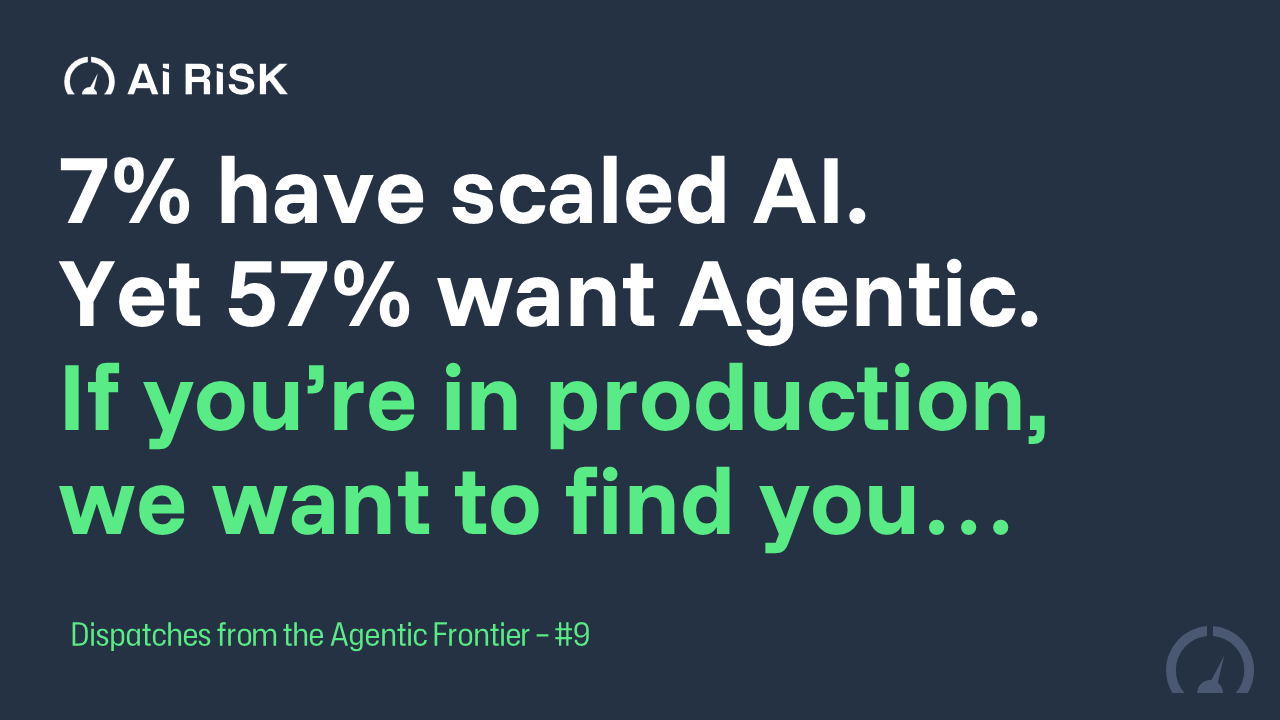
Fifty-seven per cent of insurance executives list agentic AI as a top investment priority for 2026, according to PwC. Their record at scaling even conventional AI does not support that confidence.
Introduction
Sixty-five per cent of European insurers are already using generative AI, according to EIOPA's February 2026 survey of 347 undertakings across 25 EU/EEA countries. That sounds like progress. The detail says otherwise: the vast majority of those deployments are still at proof-of-concept stage. BCG puts the number of carriers that have achieved enterprise-wide AI scaling (the kind that redesigns end-to-end business processes with sustained investment) at 7%. McKinsey's recent data tells the same story from a different angle: roughly two-thirds of organisations across industries have not begun scaling AI at all.
The industry has adopted AI broadly, but has failed to scale it. And now 57% of its executives want to prioritise agentic AI, a technology that is structurally harder to deploy than anything that came before it.
Agentic AI requires cross-functional architecture from day one. It demands governance for systems that make autonomous decisions. It needs human oversight designed into the operating model from the start. Every weakness that prevented conventional AI from scaling (siloed teams, fragmented data, deferred architecture decisions) will compound faster with agentic systems, because agentic systems operate across organisational boundaries by design.
The scaling record: four patterns
BCG has found that roughly 70% of the barriers to AI scaling are organisational and human. These patterns are consistent across every major survey.
Organisations chose the safest use case. The typical AI pilot targets a low-risk, low-complexity process, something where failure won't embarrass anyone. The result is a working demo that proves the technology functions, and a business case too small to justify enterprise investment. The pilot succeeds. The programme dies. This pattern is even more destructive with agentic AI, because the value of agentic systems comes from operating across functions. A small, contained pilot cannot demonstrate cross-functional compounding. It can only demonstrate that the technology works in isolation. That was never the question.
Architecture was treated as a problem to solve later. Integration, data governance, and orchestration were deferred until the first use case worked. By the time it did, the architecture couldn't carry a second one. Each new deployment required its own integration, its own data pipeline, its own governance structure. Costs scaled linearly with use cases. Value didn't. LIMRA found in 2025 that 78% of global life insurers identified data readiness as their single biggest barrier to getting value from AI.
Human oversight was designed wrong. Some organisations deployed with no human oversight and hit governance walls immediately. Others kept humans as final-stage approvers, a compliance checkbox that captured no data and generated no learning. Neither approach produces the feedback loops that let systems improve over time. For agentic AI, where the system is making multi-step decisions autonomously, the cost of getting human oversight wrong is higher and the consequences arrive faster.
Measurement came after the fact. Impact was assessed retrospectively, often by the team that built the system. Without pre-defined baselines and independent measurement, the numbers were soft enough to be challenged by anyone with a reason to challenge them. Grant Thornton's April 2026 survey found that only 24% of insurance executives are confident their organisation could pass an independent AI governance review within 90 days. The CFO had questions. The answers were unconvincing.
Why agentic AI is harder
Agentic AI deployments in insurance tripled between Q3 and Q4 2025, according to Evident Insights. Twenty-one per cent of all publicised insurance AI deployments in Q4 2025 were agentic, with 56% concentrated in claims management, the function with the highest volume of unstructured data and complex multi-step workflows. Twenty-two per cent of insurers plan to have agentic AI in production by the end of 2026.
Momentum is building, but production maturity remains thin. The organisations that have crossed from pilot into production share four characteristics, and each corrects one of the patterns that stalled the previous wave.
They went straight for a high-volume, high-friction, high-stakes process. Claims. Complex underwriting. Portfolio-level risk assessment. The difficulty forced them to build for enterprise scale from day one, because nothing else would survive contact with the problem.
They treated architecture as a first-order concern. Integration, data, governance, and orchestration were scoped before use cases scaled. The result: a coordination layer that carries the next deployment without rebuilding. One architecture decision, compounding across every function it touches.
They kept humans in the deliberative loop as the source of reasoning the system learns from. Every human decision became data. Every override was captured. The system got better because the humans using it were treated as first-class inputs.
They defined success metrics before deployment. Before-and-after measurement was designed into the programme from the start, not retrofitted once the board asked for evidence. When the results came, they were credible. Buy-in followed from demonstrated value.
McKinsey's 2025 data shows the payoff: AI-leading insurers generated 6.1 times the shareholder return of laggards over five years. The gap between these two groups will widen as agentic systems compound the advantage. Every quarter of delayed deployment is a quarter of lost compounding.
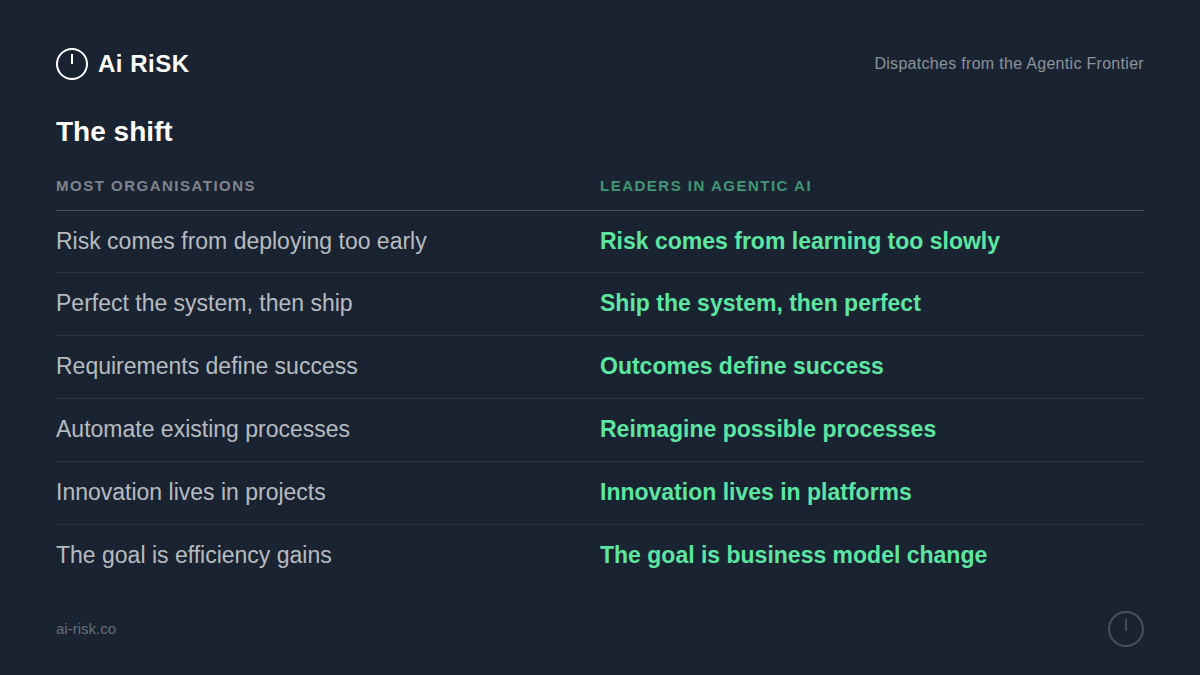
The shift
The people doing this work are the least visible
The executives who have made agentic AI work in insurance are the hardest to find. They're inside their organisations, solving problems that don't make it to conference stages. The lessons they hold (what worked, what failed, what they'd do differently) stay locked inside individual companies. The industry keeps relearning the same mistakes.
We built the Top 5 Agentic Faces in Insurance to change that.
This is the first programme dedicated to identifying the C-suite leaders who have moved agentic AI from pilot into production across European insurance. Five winners. Two recognition pathways: Production Impact (measurable results in live operations) and Architectural Readiness (the structural decisions that make compounding gains possible).
The evaluation is a 20-minute structured conversation with an independent panel. No submission documents. No glossy case studies. A direct account of what you built, what it changed, and what you learned.
Open to insurers, reinsurers, MGAs, and brokers only. No vendors or consultants.
Applications close 31 May. Do apply or nominate at topagenticfaces.com.
The event
Winners will be announced on stage at The Age of Agentic AI: From Strategy to Commercial Value on 7 July in London, a full-day programme bringing together 450 senior insurance and technology executives.
The speaker programme includes Manuela Veloso (Carnegie Mellon, former head of JPMorgan Chase AI Research), Gina Gill (CIO, Apollo), Ashok Krishnan (Chief Innovation, Data & Analytics Officer, AXA XL), Amélie Breitburd (Board Member, CNP Assurances), Pieter Viljoen (Chief Data Officer, Allianz Partners), and Erdal Atakan (COO & CTO, Inigo). Tickets start at £200.
Register at instech.co.
The 7% who scaled AI broadly didn't wait for consensus. The small number now crossing into agentic production aren't waiting either. If you're one of them, or you know someone who is, the deadline is 31 May.